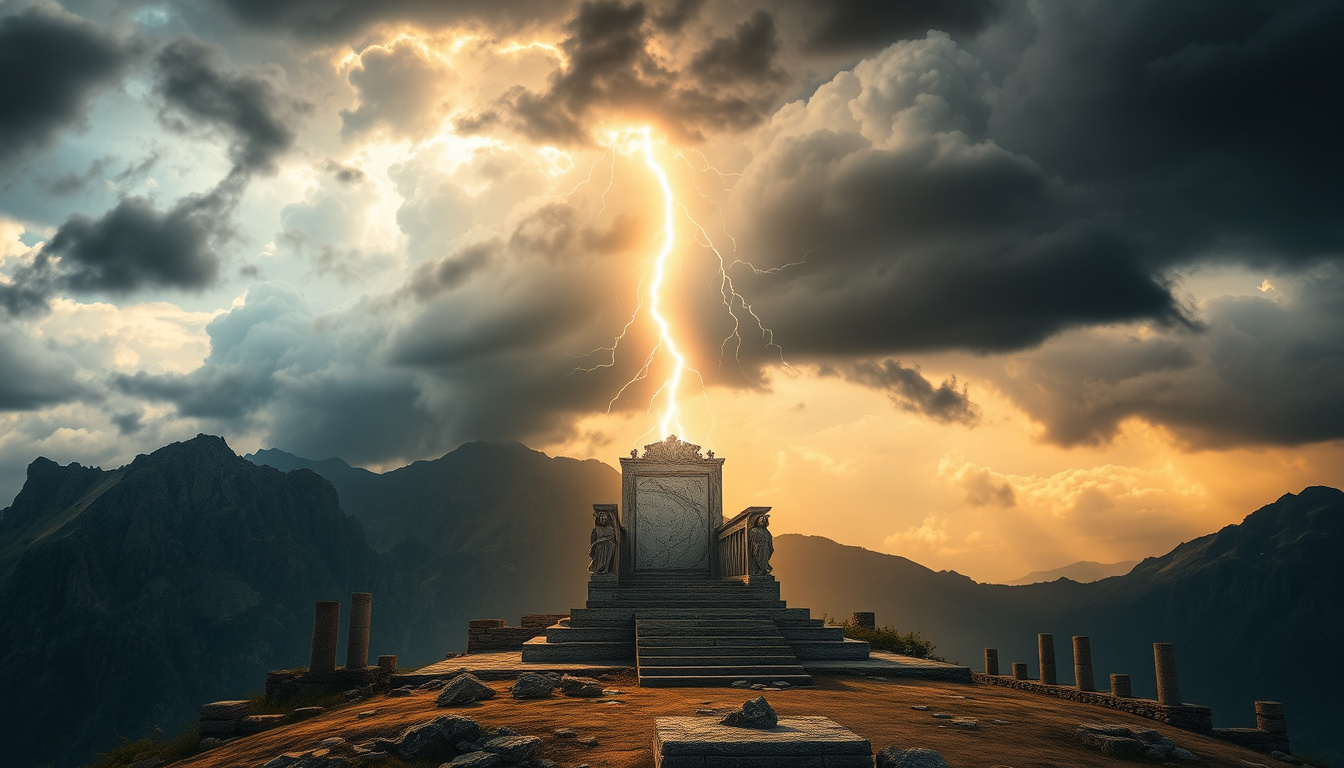
Zeus is the chief deity of the Greek pantheon, ruling the sky, thunder, and law, yet the details of his genealogy and cult practices show regional variation. For centuries, the Greeks looked to him as the supreme ruler of gods and humans alike, a god who embodied both cosmic order and startling personal flaws.
Domain: Sky, thunder, law, order, justice ·
Roman counterpart: Jupiter ·
Notable children: Athena, Apollo, Artemis, Hermes, Perseus ·
Sacred symbol: Thunderbolt ·
Primary residence: Mount Olympus
Quick snapshot
- Zeus is the chief deity of Greek religion (Encyclopaedia Britannica (reference work on world mythology))
- He overthrew his father Cronos (Theoi Greek Mythology (academic database of Greek mythology))
- He is the father of Athena, Apollo, and others (Encyclopaedia Britannica (reference work on world mythology))
- The exact number of Zeus’s children varies by source (Theoi Greek Mythology (academic database of Greek mythology))
- The full list of the 12 Olympians differs in some accounts (Encyclopaedia Britannica (reference work on world mythology))
- The precise circumstances of his birth vary across mythic traditions (Theoi Greek Mythology (academic database of Greek mythology))
- Worship of Zeus established in ancient Greece (Britannica Kids (student encyclopedia))
- Temple of Zeus at Olympia completed about 460 BCE (Encyclopaedia Britannica (reference work on world mythology))
- Zeus remains a central figure in modern culture and neo-paganism (Theoi Greek Mythology (academic database of Greek mythology))
Five key facts about Zeus, one pattern: his domains spanned sky, law, and family, but the details of his genealogy show regional variation.
| Label | Value |
|---|---|
| Alternate name | Jupiter (Roman) |
| Generation | Third generation (after Chaos, Titans) |
| Primary weapon | Thunderbolt forged by the Cyclopes |
| Notable temple | Temple of Zeus at Olympia |
| Offspring count | Over 100, including gods and heroes |
| Parents | Cronus and Rhea (Encyclopaedia Britannica (reference work on world mythology)) |
| Siblings | Poseidon, Hades, Hera, Demeter, Hestia (Theoi Greek Mythology (academic database of Greek mythology)) |
| Consort | Hera (Wikipedia (online encyclopedia)) |
| Sacred animal | Eagle (Britannica Kids (student encyclopedia)) |
| Symbols | Thunderbolt, eagle, bull, oak tree (Britannica Kids (student encyclopedia)) |
What is Zeus the god of?
Zeus and the Sky
- Zeus is the god of the sky and weather, controlling thunder, lightning, rain, and winds (Encyclopaedia Britannica (reference work on world mythology)).
- He is also the god of law, order, and justice, acting as the protector of kings and the avenger of broken oaths (Britannica Kids (student encyclopedia)).
Zeus as King of the Gods
- Zeus is widely presented as the ruler, protector, and father of gods and humans (Encyclopaedia Britannica (reference work on world mythology)).
- He resides on Mount Olympus with the other major gods (Britannica Kids (student encyclopedia)).
Symbols of Zeus
- His primary symbol is the thunderbolt, often depicted in art and literature (Britannica Kids (student encyclopedia)).
- The eagle, bull, and oak tree are also sacred to him (Theoi Greek Mythology (academic database of Greek mythology)).
Zeus’s role as sky god gave him unmatched authority, but his duties as lawgiver meant he also had to enforce order — even when that meant punishing his own kin.
The implication: The sky god’s power was absolute, but his justice was bound by the same rules he imposed on others.
What are 5 facts about Zeus?
Zeus overthrew Cronos
- After a 10-year war against the Titans, Zeus emerged victorious and became chief god (Britannica Kids (student encyclopedia)).
Zeus is the youngest child of Cronos and Rhea
- In the classical mythic account, Zeus is the youngest of the six siblings (Theoi Greek Mythology (academic database of Greek mythology)).
Zeus had many children
- He fathered numerous gods and heroes, including Athena, Apollo, Artemis, Hermes, and Perseus (Encyclopaedia Britannica (reference work on world mythology)).
Zeus punished Prometheus
- He chained Prometheus to a rock for giving fire to humans, sending an eagle to eat his liver daily (Theoi Greek Mythology (academic database of Greek mythology)).
Zeus married Hera
- In most traditions, Zeus is married to Hera, though his many affairs are a recurring theme in myths (Wikipedia (online encyclopedia)).
Zeus’s power as king was absolute, but his personal relationships often created chaos — a pattern that ancient storytellers used to explain both natural and human conflict.
The pattern: Each fact about Zeus reveals a tension between his supreme authority and his personal choices, a duality the Greeks used to explore power and its limits.
Was Zeus a god in the Bible?
Zeus in Biblical context
- Zeus is not a god in the Bible. The Bible mentions Greek gods in Acts 14:12, where Paul and Barnabas are mistaken for Zeus and Hermes (Encyclopaedia Britannica (reference work on world mythology)).
Comparison with the God of the Bible
- Unlike the monotheistic God of the Bible, Zeus is part of a polytheistic pantheon and has human-like flaws and limitations (Theoi Greek Mythology (academic database of Greek mythology)).
The implication: While Zeus shares the title “king of the gods” with the divine father in the Bible, the two figures are fundamentally different in nature and worship.
What makes Zeus angry?
Disrespect to guests
- Zeus was the protector of strangers and guests, and he punished violations of Xenia (hospitality rules) (Britannica Kids (student encyclopedia)).
Breaking oaths
- He was the avenger of broken oaths and other offenses (Britannica Kids (student encyclopedia)).
Defying his will
- Zeus struck down those who directly challenged his authority, such as the Titans and the giant Typhon (Theoi Greek Mythology (academic database of Greek mythology)).
The pattern: Zeus’s anger was not random; it was a mechanism for enforcing the rules that held Greek society together.
Who does Zeus fear?
Nemesis
- Zeus feared the prophecy that a child of Metis would overthrow him, which led him to swallow Metis (Theoi Greek Mythology (academic database of Greek mythology)).
The Fates
- Even Zeus respected the Fates (Moirai), who determined the destinies of both gods and mortals (Encyclopaedia Britannica (reference work on world mythology)).
The prophecy of his downfall
- He avoided angering Nyx, the goddess of night, and heeded warnings about potential successors (Theoi Greek Mythology (academic database of Greek mythology)).
The pattern: Zeus’s power, while supreme, was not absolute. He operated within a framework of fate and prophecy that even he could not escape.
“Zeus is identified with the Roman god Jupiter, and his role as chief deity continues to influence modern depictions of sky gods.”
— Encyclopaedia Britannica (reference work on world mythology)
“Zeus is the god of law, order, destiny, and kingship, as well as the father of gods and men.”
— Theoi Greek Mythology (academic database of Greek mythology)
Confirmed facts
- Zeus is the father of Athena (born from his head) (Encyclopaedia Britannica (reference work on world mythology))
- He ruled from Mount Olympus (Britannica Kids (student encyclopedia))
- He overthrew his father Cronos (Theoi Greek Mythology (academic database of Greek mythology))
What’s unclear
- The exact number of Zeus’s children varies by source (Theoi Greek Mythology (academic database of Greek mythology))
- The full list of the 12 Olympians differs in some accounts (Hestia vs. Dionysus) (Encyclopaedia Britannica (reference work on world mythology))
- The precise circumstances of his birth vary across traditions (Theoi Greek Mythology (academic database of Greek mythology))
Timeline
- Ancient Greek period: Worship of Zeus established across Greek city-states (Britannica Kids (student encyclopedia))
- 5th century BCE: Temple of Zeus at Olympia completed, housing the Statue of Zeus (Encyclopaedia Britannica (reference work on world mythology))
- Roman period: Zeus identified with Jupiter, adopted into Roman state religion (Encyclopaedia Britannica (reference work on world mythology))
- Modern era: Zeus remains a central figure in popular culture and neo-paganism (Theoi Greek Mythology (academic database of Greek mythology))
The takeaway: The worship of Zeus spanned millennia and adapted to changing cultures, but his core identity as sky king stayed remarkably consistent.
For anyone exploring Greek mythology today, the story of Zeus is a reminder that even the most powerful being in the universe was bound by rules of fate, justice, and family. The implications for modern readers interested in mythology, religion, or cultural history: the character of Zeus offers a rich lens through which to understand how ancient peoples made sense of power, order, and human fallibility. For enthusiasts of Greek mythology, the choice is clear: dive into the primary sources from Theoi and Britannica to separate myth from interpretation, or risk relying on simplified modern retellings.
kids.britannica.com, britannica.com, britannica.com, kids.britannica.com, britannica.com, en.wikisource.org, fr.wikipedia.org
For a deeper look at Zeuss role as king of the gods, readers can explore how his myths and symbols have been interpreted across different sources.
Frequently asked questions
Is Zeus the most powerful Greek god?
Yes, Zeus is considered the most powerful Greek god, as king of the Olympians and ruler of the sky, thunder, and law (Encyclopaedia Britannica (reference work on world mythology)).
Did Zeus have a wife?
Yes, Zeus was married to Hera, the goddess of marriage and family (Wikipedia (online encyclopedia)).
What is Zeus’s Roman name?
Zeus’s Roman counterpart is Jupiter (Encyclopaedia Britannica (reference work on world mythology)).
How did Zeus become king of the gods?
Zeus led a rebellion against the Titans, overthrew his father Cronos, and after a ten-year war became the chief god (Britannica Kids (student encyclopedia)).
What does Zeus’s symbol represent?
His thunderbolt represents his control over the sky and weather, while the eagle symbolizes his kingship (Theoi Greek Mythology (academic database of Greek mythology)).
Are there any living temples of Zeus?
The Temple of Zeus at Olympia is in ruins, but the site is a UNESCO World Heritage area and a major archaeological attraction (Encyclopaedia Britannica (reference work on world mythology)).
How is Zeus portrayed in modern media?
Zeus appears in films, video games, and literature, often as a powerful but flawed father figure, as in Disney’s Hercules and the God of War series (Theoi Greek Mythology (academic database of Greek mythology)).
Related stories





Daniel Campbell is Editor-in-Chief at True North Brief, overseeing editorial standards, publication decisions and corrections.