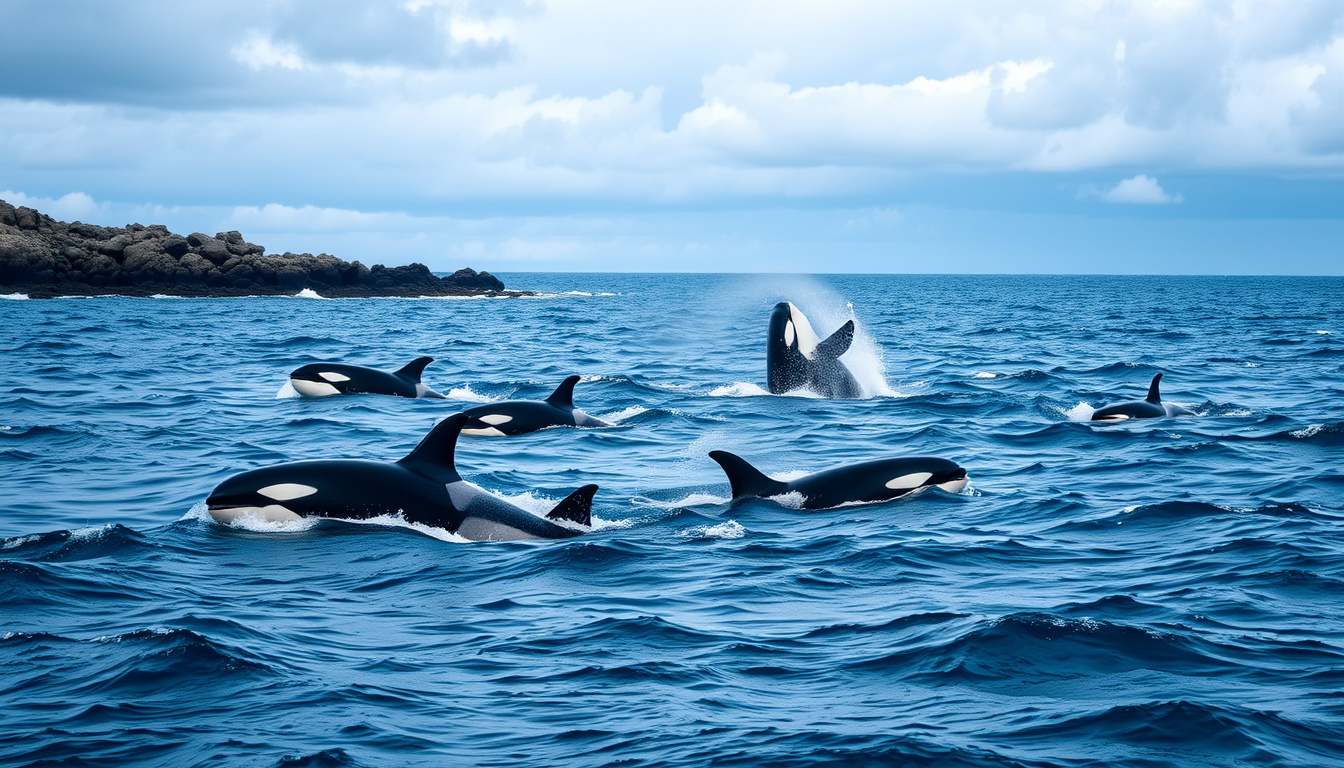
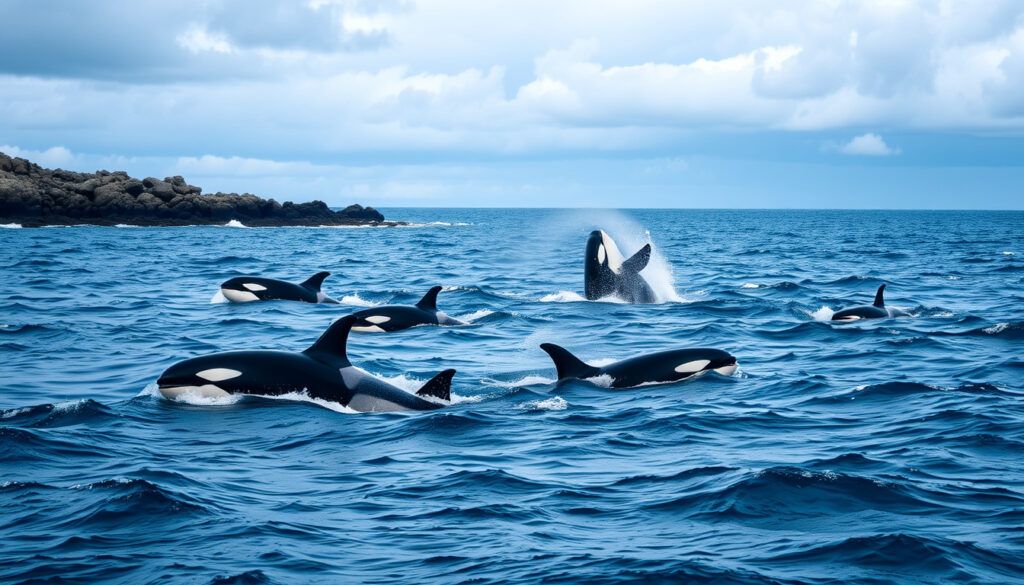
Few animals pull you in the way the killer whale does — a black-and-white hunter that roams every ocean and lives in family groups most of us can understand. This guide sorts the science from the folklore: how orcas hunt, how long they live, whether they attack boats, and why some populations are in far deeper trouble than others.
Scientific name: Orcinus orca ·
Average lifespan (wild): 50–80 years ·
Maximum length: 32 feet (9.8 m) ·
Top speed: 35 mph (56 km/h) ·
Population status: Data deficient (some populations endangered)
Quick snapshot
- The largest member of the dolphin family, found in every ocean (International Whaling Commission (global whale conservation body))
- Diet is cultural: fish for resident pods, marine mammals for Bigg’s pods (Encyclopedia of Puget Sound (regional marine research hub))
- Hunting is coordinated, learned, and passed down through generations (Duke OBIS-SEAMAP (marine species database))
- Why orcas approach boats is still an open research question (Wikipedia (ocean-life reference))
- Wild encounters are rarer than the news cycle suggests (NOAA Fisheries (U.S. ocean agency))
- Southern Resident orcas are down to about 73 individuals (National Fish and Wildlife Foundation (conservation fact sheet))
- Global status is Data Deficient, hiding sharp regional differences (IUCN Red List (global extinction-risk authority))
Seven numbers define the species at a glance — and the pattern they reveal is an animal built for power, with a conservation label that hides big regional differences.
| Attribute | Value |
|---|---|
| Scientific Name | Orcinus orca |
| Family | Delphinidae (oceanic dolphins) |
| Average Length | 16–26 ft (5–8 m) |
| Average Weight | 3–6 tons |
| Top Speed | 35 mph (56 km/h) |
| Diet | Fish, squid, seals, whales |
| Conservation Status | Data Deficient (IUCN) |
Which one is the killer whale?
The first thing to clear up is the name. Orcinus orca is the largest member of the dolphin family, and the English label “killer whale” is a historical accident: early Spanish whalers called the species “whale killer” after watching pods hunt animals far larger than themselves, and the phrase got flipped in translation (International Whaling Commission (global whale conservation body)). The animal is not a whale in the biological sense — it’s a dolphin.
Why are orcas called killer whales?
“Killer whale” describes what the species does to other whales — not what it does to people.
The name had nothing to do with danger to humans. It was a report from the water: whalers watched orcas working together to take down large prey, and “whale killer” entered logbooks as a description of hunting skill, not bloodlust.
Which whale has 13 stomachs?
No whale has 13 separate stomachs. The viral number usually comes from conflating multi-chambered stomachs with distinct organs.
Whales that gulp enormous meals need extra digestive help, and some species have chambered stomachs that look like multiple organs. Killer whales, as dolphins, process their food through a compartmentalized stomach — efficient, but nowhere close to 13.
There is officially one killer whale species, but that single label hides a lot of variety. Researchers now describe distinct lineages and ecotypes; in the North Pacific, the clearest example is the split between resident, Bigg’s (transient), and offshore orcas, which differ in what they eat, how they raise their young, and where they travel (NOAA Fisheries (U.S. ocean agency)).
The pattern: the most famous “whale” in the ocean isn’t a whale — and one species label hides a collection of very different orca cultures. That distinction shapes which populations get protected and how.
Do orcas hunt blue whales?
Orcas are apex predators, and they hunt the way families do: together. Pods use herding, wave-washing, and — in a few famous places — intentional stranding to catch prey that would be impossible for a single animal (Duke OBIS-SEAMAP (marine species database)). Their diet is cultural rather than fixed: resident orcas in the northeastern Pacific eat mostly fish, especially salmon, while Bigg’s (transient) orcas specialize in marine mammals, and the menu sometimes extends to other whales, including blue whale calves (Encyclopedia of Puget Sound (regional marine research hub)).
Who is the biggest enemy of orcas?
The only predator an adult orca genuinely needs to fear is us.
For the Southern Resident community, the pressure is measurable: vessel noise interferes with hunting, pollutants accumulate in the food chain, and the chinook salmon at the center of their diet have collapsed in several key rivers (National Fish and Wildlife Foundation (conservation fact sheet)).
The implication: when we talk about orca conservation, we’re protecting family lines and learned skills, not just a body count.
Do killer whales attack boats?
The short answer is almost never. In the wild, no confirmed fatal attack on a human has ever been recorded, and most boat encounters are brief, non-lethal, curiosity-driven events rather than attacks (NOAA Fisheries (U.S. ocean agency)). The fatal exceptions belong to captivity — a context defined by stress and confinement that tells us little about wild orcas.
“Attack” implies intent. Researchers see a more complex picture: an intelligent animal probing, playing, or defending — rarely hunting.
Are killer whales friendly to humans?
“Friendly” is the wrong word. Orcas are curious, intelligent, and sometimes playful — admiration from a distance is the safest frame.
Accounts from the water tend to describe inspection rather than aggression: orcas circling, looking, sometimes mirroring a boat’s movement. The respectful interpretation is that they are aware of us, interested, and entirely capable of setting their own boundaries.
The trade-off: the more we share the water with orcas, the more we need rules that protect them from us — and us from the temptation to treat them as entertainment.
How long do killer whales live?
Wild orcas are among the longest-lived marine mammals: females typically live 50 to 80 years, and the oldest documented individuals reach roughly 90 (NOAA Fisheries (U.S. ocean agency)). A life that long, with decades of accumulated knowledge, is one reason orca culture runs so deep.
Globally, the IUCN Red List classifies the species as Data Deficient — not a clean bill of health, but a warning that one global label cannot capture how differently each population is faring (IUCN Red List (global extinction-risk authority)).
What whale lives for 300 years?
- Bowhead whales are the longest-lived whales — confirmed at over 200 years (Wikipedia (ocean-life reference))
No whale is confirmed to reach 300. The “300-year whale” that drifts around the internet is usually a garbled version of bowhead longevity research, or a mix-up with a different animal entirely.
Are there only 73 orcas left?
- 73 refers to the Southern Resident population — the only resident killer whale population in the U.S. (National Fish and Wildlife Foundation (conservation fact sheet))
That number is not a global headcount. It is one community of orcas in the Pacific Northwest, and its decline is tied to the collapse of the chinook salmon runs they depend on, plus vessel noise and accumulated pollutants.
A single population of 73 orcas is not a global count — it’s a global warning.
Why this matters: a species that lives this long and builds knowledge over decades cannot bounce back quickly. Every adult lost in a small population is a library lost.
Do killer whales ever sleep?
They have to — but they do it on their own terms. Orcas use unihemispheric slow-wave sleep, resting one half of the brain while the other half stays alert enough to breathe and navigate (Wikipedia (ocean-life reference)). In practical terms, a resting pod often swims slowly and synchronously, moving together in the same direction while half asleep.
An orca never “falls asleep” the way we do. One half of its brain is always on duty.
What this means: even rest is a social act for orcas — another quiet reminder that they rarely do anything alone.
Do killer whales mourn their dead?
There is documented behavior that reads as grief. In multiple populations, mother orcas have been seen carrying dead calves for days, lifting them to the surface and staying with the body long after death (Wikipedia (ocean-life reference)).
The behavior makes sense inside the species’ social structure, where family bonds are the center of life. Researchers are careful, though: whether that behavior equals human-style grief — or something we don’t have a word for — is still an open question.
The behavior is real; the emotion behind it is not yet measurable.
The takeaway: orcas carry their dead because their living bonds are that strong — and that is worth protecting regardless of what we call it.
What’s confirmed — and what’s still unclear
Confirmed facts
- Killer whales are dolphins, not true whales (Encyclopedia of Puget Sound (regional marine research hub))
- Resident orcas remain in their mother’s pod for life (Duke OBIS-SEAMAP (marine species database))
What’s unclear
- Whether boat encounters are intentional aggression or curiosity
- Whether carrying dead calves reflects grief in the human sense
- The true global population size — the species is too wide-ranging to count precisely
Why this matters: the uncertainty is not an excuse to ignore the science — it’s a reason to keep studying, and to treat an intelligent marine predator with humility.
What researchers say
“The hunts are coordinated: herding fish, generating waves, ramming prey, and in a few populations intentionally stranding in shallow water to reach the catch.”
— Researcher, Duke OBIS-SEAMAP marine species database
“Resident killer whales primarily eat fish, especially salmon, whereas Bigg’s, or transient, killer whales specialize mainly in marine mammals.”
— Marine ecologist, Encyclopedia of Puget Sound regional marine research hub
A final word
Orcas are not the monsters of seafaring legend, and they are not the smiling performers of marine-park branding. They are the largest dolphins on Earth, with local cultures, long memories, and real conservation problems. For anyone who meets them on the water — whale watcher, boater, or fisher — the respectful choice is clear: give them room, cut the noise, and let a family that has been together for generations pass by in peace.
Frequently asked questions
How do killer whales communicate?
Orcas are highly vocal animals. Different populations use distinct call repertoires, so a pod in one region can sound almost like a different “language” to a pod elsewhere (International Whaling Commission (global whale conservation body)).
What do killer whales eat?
Their menu is learned, not instinctual: resident pods favor fish, especially salmon, while Bigg’s pods hunt marine mammals, and the list can extend to other whales (see the diet section above).
Are killer whales endangered?
Globally, the IUCN lists the species as Data Deficient, because regional populations show very different trends (IUCN Red List (global extinction-risk authority)). Some populations, like the Southern Residents, are in critical trouble even though the species as a whole is wide-ranging.
Do killer whales sleep?
Yes — with half their brain at a time. Unihemispheric slow-wave sleep lets them rest while keeping enough awareness to breathe and stay with the pod (see the sleep section above).
Is an orca a whale or a dolphin?
An orca is a dolphin — the largest member of the Delphinidae family (see the classification section above).
Related reading
Related stories





Daniel Campbell is Editor-in-Chief at True North Brief, overseeing editorial standards, publication decisions and corrections.