
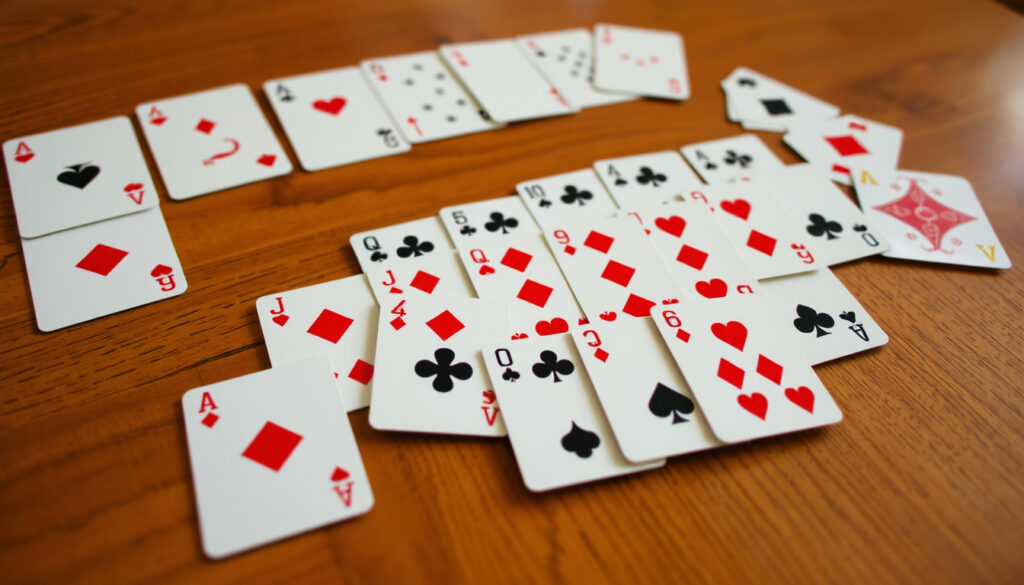
Klondike Solitaire Turn 3 challenges even seasoned players by dealing three cards at a time from the stockpile, demanding more strategic foresight than its Turn 1 counterpart. This guide breaks down the rules, strategies, and best places to play this classic variant for free online.
Deck size: 52 cards | Cards drawn per turn: 3 | Number of foundation piles: 4 | Initial face-down cards: 24 | Typical win rate: ~5-10% | Number of tableau columns: 7
Solitaire Bliss
- Free to play
- No registration required
- Undo and hint features
- Clean interface
Solitaired
- 100% free
- Multiple game modes
- Statistics tracking
- Mobile friendly
Green Felt
- Innovative gameplay features
- No ads option
- Customizable settings
- Smooth animations
Solitaire.net
- Free online play
- Undo, hints, auto-solve
- Challenging Turn 3
- Responsive design
| Game Type | Klondike Solitaire |
|---|---|
| Variant | Turn 3 (Draw Three) |
| Deck | Standard 52-card |
| Number of Players | 1 |
| Foundation Piles | 4 (one per suit) |
| Tableau Columns | 7 |
| Stockpile Draw | 3 cards at a time |
| Win Rate | Approximately 5-10% |
Where can I play Klondike Solitaire Turn 3 online for free?
Several reputable websites offer free Klondike Turn 3 with no registration required. Each platform provides unique features that can enhance your experience.
Top free sites for Klondike Turn 3
- Solitaire Bliss – Offers a clean, ad-light interface with undo and hint tools. Source: Solitaire Bliss official site.
- Solitaired – Provides 100% free play with statistics tracking and multiple game modes. Source: Solitaired – Turn 3.
- Green Felt – Features smooth animations and a no‑ads option. Source: Green Felt Klondike.
- Solitaire.net – Responsive design with auto‑solve for practice. Source: Solitaire.net Turn 3.
- 247 Solitaire – Quick start, no download needed. Source: 247 Solitaire Turn 3.
Players who value statistics should choose Solitaired; those who prefer a distraction‑free experience can opt for Green Felt’s no‑ads mode.
Features to look for in a free online game
- Undo and hint capabilities (most sites offer them).
- Mobile responsiveness for play on smartphones.
- No registration or payment walls.
- Customizable card designs and backgrounds.
What are the rules of Klondike Solitaire Turn 3?
Klondike Solitaire Turn 3 follows the same fundamental rules as standard Klondike, with the key difference being the stockpile draw mechanism. Below we outline the objective, setup, and specific rules.
Objective and setup
You play with a standard 52‑card deck. The tableau consists of seven piles: the first pile has one card, the second two, and so on up to seven cards in the seventh pile. The top card of each tableau pile is face‑up; the rest are face‑down. The remaining 24 cards form the stockpile. The goal is to build four foundation piles, one per suit, in ascending order from Ace to King (Britannica).
Stockpile and draw rules
In Turn 3, the stockpile deals three cards at a time onto a waste pile. Only the topmost card of the waste pile is immediately playable. If you cannot use any of the three drawn cards, they remain in the waste pile and cannot be accessed until you cycle through the entire stock (Solitaired). This limitation makes Turn 3 considerably more restrictive than Turn 1.
Tableau and foundation rules
- Tableau columns are built down by alternating colors (e.g., red on black). Only a King or a sequence starting with a King can fill an empty column (BVS Solitaire).
- Foundations are built up by suit from Ace to King. Aces can be moved to the foundation immediately upon becoming available (wikiHow).
- Only the top card of a tableau pile is normally available; uncovering face‑down cards is a primary strategic goal (SolitaireX).
“In Klondike Solitaire Turn Three, you build four foundation piles in ascending order by suit and the stockpile deals three cards at a time.” — Solitaire Bliss
How does Klondike Solitaire Turn 3 differ from Turn 1?
The draw mechanic fundamentally changes how you approach each move. The following comparison table highlights the key differences.
| Aspect | Turn 1 (Draw 1) | Turn 3 (Draw 3) |
|---|---|---|
| Cards drawn per turn | 1 | 3 |
| Card immediately playable | The drawn card | Only the top of the three |
| Stock cycle strategy | Simple, every card visible eventually | Must plan which card becomes accessible next |
| Typical win rate | ~20% (with good play) | ~5-10% |
| Difficulty level | Easier | Harder, requires more planning |
The pattern: Turn 3 forces you to think ahead because many desirable cards remain buried until you cycle through the stock multiple times. This makes each decision more consequential.
Draw mechanics
Turn 1 lets you see and play every card in the stock individually. Turn 3 groups cards in triples, and only the third card (the top after dealing) is accessible. The other two are locked until that triple is recycled (Britannica).
Difficulty and win rates
Due to the increased restriction, Turn 3 is widely considered more challenging. Win rates fall to approximately 5–10%, compared to around 20% for Turn 1 (SolitaireX).
Strategic differences
- In Turn 3, avoid playing a card from the stock if it blocks a more useful card later – order matters (Solitaired).
- Preserve empty tableau columns for Kings, but not at the cost of uncovering face‑down cards needlessly.
“Turn 3 is a version of Klondike Solitaire where 3 cards are drawn from the stock pile at once. Only the top card of the 3 can be played.” — Solitaired
Can I download Klondike Solitaire Turn 3?
Most free online versions are browser‑based and do not require a download. However, several options exist for those who prefer a local application.
Browser-based vs downloadable apps
Browser‑based platforms like Solitaire Bliss and Green Felt work instantly without installation. For offline play, mobile apps (iOS/Android) often include Klondike Turn 3 as a variant. Notable downloadable titles: “Microsoft Solitaire Collection” (includes Turn 3) and “Solitaire by MobilityWare” (free with optional ads) (YouTube tutorial).
Available platforms
- Windows, macOS: Browser or Microsoft Store.
- iOS, Android: App stores offer numerous free Klondike variants.
- Linux: Browser‑based options work well.
Note: Browser versions often have the same functionality as apps and save your progress via cookies. No official download exists from most of the top sites mentioned – they rely on web technologies.
What is the best strategy for winning Klondike Solitaire Turn 3?
Winning Turn 3 requires patience and deliberate planning. Below are three core strategies, followed by a step‑by‑step guide.
Using empty columns effectively
Empty tableau columns are valuable assets in Turn 3. Only a King (or a King‑led sequence) can fill them, so avoid creating an empty column unless you have a King ready to move there. Prematurely emptying a column without a King wastes a strategic slot (BVS Solitaire).
Prioritizing face-down cards
Moves that uncover face‑down cards increase your future options. In Turn 3, the stock is less generous, so tableau cards become the primary source of new moves. Aim to reveal as many hidden cards as possible, even if it means delaying foundation play (SolitaireX).
Undo and hint features
Many online sites offer undo and hint buttons. Use undo to experiment without penalty; hints can reveal optimal moves. However, relying on hints can prevent you from learning the underlying strategy. Use them as teaching tools, not crutches.
- Scan the waste pile first. Before moving any tableau card, check if the top waste card can be played to the tableau or foundation. This minimizes missed opportunities.
- Play Aces and Twos immediately. These cards are low‑value in the tableau and should go to the foundation as soon as possible to free up space (SolitaireX).
- Don’t rush to fill empty columns. Wait until you have a King to occupy an empty space, unless filling it with a non‑King temporarily helps uncover a crucial card.
- Cycle the stockpile mindfully. Know that only every third card becomes directly playable. If the top waste card is not useful, consider passing the turn to cycle toward better options.
- Delay foundation moves of mid‑rank cards. A 7 of hearts, for example, might be more useful on the tableau to build sequences than in the foundation early on (YouTube strategy video).
Strategic insight: In Turn 3, every move that exposes a face‑down card is a win, even if it seems small. Focus on expanding the tableau rather than rushing the foundation.
Common mistake: Players often send every playable card to the foundation immediately, forgetting that those cards could help build longer tableau sequences. Hold back when the tableau still has many face‑down cards.
Related reading: Solitaired – Turn 3 · SolitaireX – Solitaire Turn 3 Strategies
While the Turn 3 draw adds a layer of difficulty, players seeking a more forgiving experience might prefer the Turn 1 variant of Klondike, which lets you draw one card at a time from the stock.
Frequently Asked Questions
What is the objective of Klondike Solitaire Turn 3?
To move all 52 cards to the four foundation piles, sorted by suit from Ace to King.
How many cards are in the stockpile initially?
24 cards are in the stockpile; the remaining 28 are in the tableau.
Can I undo a move in Klondike Turn 3?
Yes, most online versions (e.g., Solitaire Bliss, Solitaired) provide an undo button.
Is there a time limit in online Klondike Turn 3?
No, the game is not timed in standard free versions. Some sites offer timed modes as an option.
What happens when I run out of stockpile cards?
The waste pile is recycled – you can turn it over and deal again from the top as if it were a new stockpile.
How do I move a card from the waste pile?
Click on the waste pile’s top card and drag it to a tableau column or foundation pile. Only the top card of the waste pile is movable.
Are there any cheats or shortcuts for Klondike Turn 3?
Not in legitimate games. Hint and undo features are built‑in aids. No hidden cheats exist in official versions.
Can I play Klondike Turn 3 on my mobile device?
Yes, mobile‑friendly sites like Solitaired and Solitaire.net work well on smartphones. There are also dedicated apps in app stores.
Related stories





Ryan Clarke is Senior Markets Reporter at True North Brief, covering breaking stories and explainers.