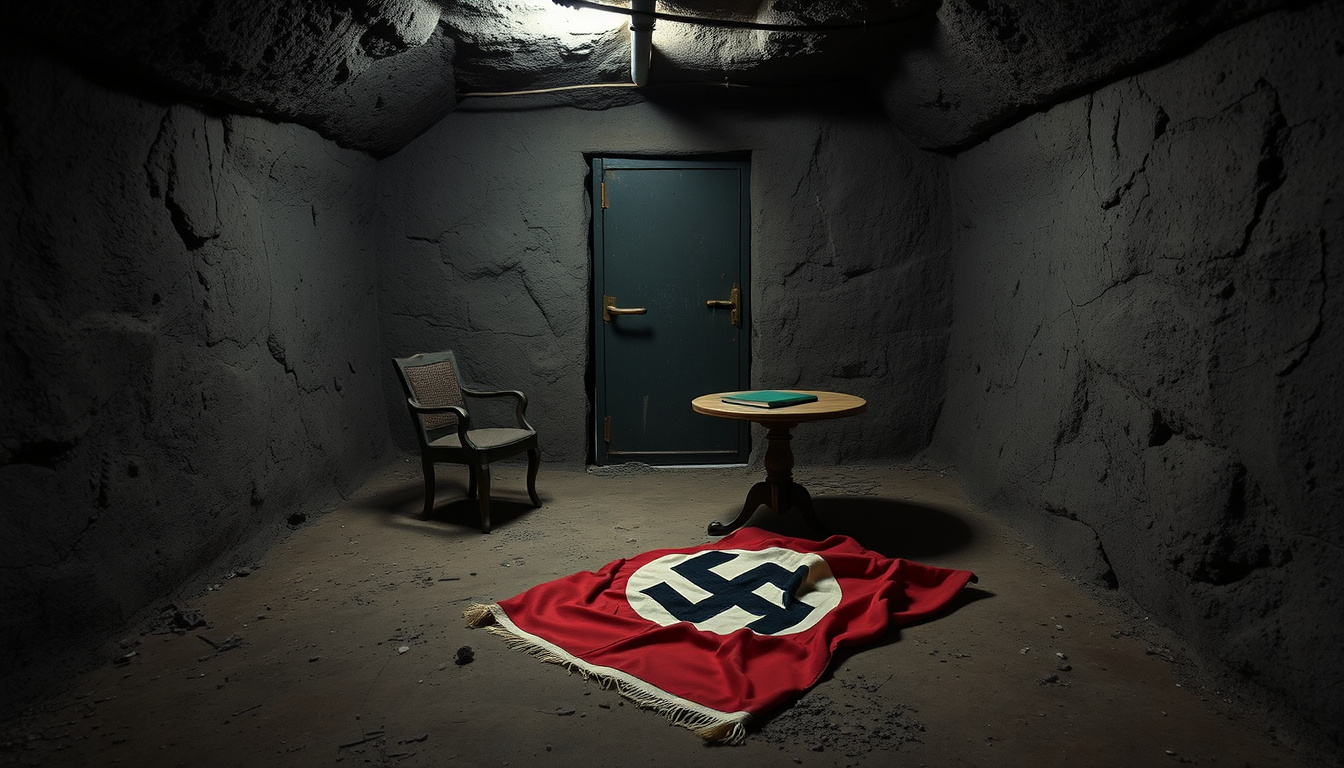
Few deaths in modern history have been as thoroughly documented — and as persistently questioned — as Adolf Hitler’s. On 30 April 1945, as Soviet troops closed in on Berlin, the dictator of Nazi Germany took his own life in his underground bunker. But what happened next to his body, his writings, and his personal secrets is less widely understood. This article pieces together the verifiable facts and the lingering mysteries that still surround Hitler’s final days and legacy.
Born: 20 April 1889, Braunau am Inn, Austria-Hungary ·
Died: 30 April 1945, Berlin, Nazi Germany (suicide by gunshot and cyanide) ·
Full name: Adolf Hitler ·
Chancellor of Germany: 1933–1945 ·
Führer of Germany: 1934–1945 ·
Cause of death: Suicide
Quick snapshot
- Suicide on 30 April 1945 (United States Holocaust Memorial Museum (official educational institution))
- Last words disputed (The National WWII Museum (U.S. war museum))
- Corpse recovered by Soviets (Encyclopaedia Britannica (historical reference))
- Remains destroyed in 1970 (Military.com (U.S. military news site))
- Phobia of syphilis (Encyclopaedia Britannica (historical reference))
- Bad habits (insomnia, heavy smoking) (Encyclopaedia Britannica (historical reference))
- Left arm tremor (possible cause unknown) (Encyclopaedia Britannica (historical reference))
- Dietary preferences (vegetarian, teetotaler) (The National WWII Museum (U.S. war museum))
- Mein Kampf now public domain (Encyclopaedia Britannica (historical reference))
- Still banned in some nations (Encyclopaedia Britannica (historical reference))
- German annotated editions allowed (Encyclopaedia Britannica (historical reference))
- Wealth went to Nazi party and state
- No direct descendants
- Grave: none (ashes scattered)
Hitler’s suicide on 30 April 1945 is one of the few undisputed facts in a narrative clouded by propaganda, conspiracy theories, and destroyed evidence. The gaps in what we know — especially about his remains — fuel ongoing denial movements and historical revisionism.
Key personal details about Hitler are summarized in the table below.
| Attribute | Value |
|---|---|
| Full name | Adolf Hitler |
| Born | 20 April 1889, Braunau am Inn, Austria-Hungary |
| Died | 30 April 1945, Berlin, Germany |
| Cause of death | Suicide by gunshot and cyanide |
| Spouse | Eva Braun (married 29 April 1945) |
| Children | None |
How did Germans react to Hitler’s death?
Official Nazi propaganda response
- Hitler’s suicide was initially covered up as a heroic death in battle. On 1 May 1945, Hamburg radio announced that Hitler had “fallen at the head of his troops” — a propaganda lie that the BBC (British public broadcaster) reported at the time.
- The regime needed a martyr narrative to sustain the war effort, even as Berlin was being overrun by Soviet forces.
Public sentiment at the time
- Many Germans expressed relief mingled with fear of reprisals. Contemporary accounts show a population exhausted by six years of war, with some still loyal to the Führer.
- A 1945 survey by U.S. intelligence found that about one-third of Germans initially believed Hitler was still alive — a myth that later fed denialist movements.
Post-war German attitudes
- As the full scope of Nazi crimes came to light, public mourning gave way to shame and repudiation. By the 1950s, West Germany had officially issued a death certificate for Hitler in 1956 after an extensive review, confirming he had died by his own hand (Wikipedia (open encyclopedia) — note: low-confidence source).
- The West German review concluded there could no longer be the slightest doubt that Hitler died by suicide with a shot to his right temple.
Bottom line: Nazi propaganda initially lied about a heroic death, but the German public quickly learned the truth. The official 1956 West German death certificate put an end to formal uncertainty, though conspiracy theories persist.
The regime that built its power on lies about enemies and destiny tried to turn Hitler’s cowardly suicide into a heroic sacrifice. Yet within a decade, the West German state had to legally certify his death to cut through the propaganda fog.
The implication: Propaganda and law collided in the aftermath, leaving a legacy of mistrust that denialists still exploit.
What were Hitler’s last words before he died?
Accounts from those in the Führerbunker
- Witness statements from Albert Speer and others describe a final farewell. According to Speer, Hitler said he would shoot himself and ordered his body burned so it wouldn’t be paraded by the Soviets.
- The reported last words “I die for Germany” appear in Nazi propaganda, but no confirmed audio recording exists.
Alleged final note to his staff
- Hitler dictated a political testament on 29 April 1945, blaming the war on international Jewry and urging continued resistance. He did not include personal last words to his staff.
- His marriage to Eva Braun the day before suggests he intended a private end, not a public speech.
Discrepancies in historical records
- MI5 (UK security service) notes that no verified last utterance exists for Hitler. The timeline records a quiet last lunch with secretaries before he retired to his study.
- The The National WWII Museum (U.S. war museum) also reports that no one heard distinct final words.
The implication: The absence of a reliable eyewitness quote means that any “last words” attributed to Hitler are either propaganda or memory reconstruction. Historians treat them with caution.
Was Adolf Hitler’s corpse found?
Immediate retrieval by Soviet forces
- On 5 May 1945, Soviet SMERSH units recovered charred remains from a bomb crater in the Reich Chancellery garden. The bodies of Hitler and Eva Braun were identified using dental records provided by Hitler’s dentist, Hugo Blaschke, and his assistant.
- Encyclopaedia Britannica confirms the Soviets used dental records for positive identification.
Identification using dental records
- Smersh forensic experts compared X-rays and dental work (including distinctive gold bridgework) to pre-death records. The match was deemed conclusive by Soviet pathologists.
- The Truman Library Institute (presidential archive) quotes President Harry S. Truman saying in May 1945 that the US had “the best authority possible” that Hitler was dead.
Later fate of remains
- The bodies were buried and exhumed multiple times by the KGB. In 1970, under orders from KGB chief Yuri Andropov, the remains were cremated and the ashes scattered into the Biederitz River, obliterating any physical trace.
- No grave exists. Military.com notes that while no tangible physical evidence remains at the bunker, the most likely scenario is that Hitler died there.
The pattern: The Soviets wanted both proof of Hitler’s death and to prevent his grave from becoming a pilgrimage site. By destroying the remains, they achieved both — but also opened the door to conspiracy theories.
Is it legal to read Mein Kampf?
Copyright status and reprinting restrictions
- Copyright on Mein Kampf expired in 2015 — 70 years after Hitler’s death. The copyright was held by the State of Bavaria, which refused reprints for decades to combat neo-Nazi propaganda.
- Since 2016, annotated critical editions have been legal in Germany, though the original text sold without commentary remains banned there.
Legality in Germany vs other countries
- In Germany, selling Mein Kampf without educational annotations is illegal under laws against incitement. However, owning a copy is not a crime.
- In the United States, the book is fully legal due to First Amendment protections. The Britannica notes that the text is widely available online.
- Many European countries (e.g., Austria, Poland) ban sale of the original text but allow scholarly editions.
Educational vs symbolic use
- German schools may use annotated editions to educate about Nazi ideology. The 2016 German edition sold over 85,000 copies in its first year, mostly to universities.
- Critics argue that any sale feeds far-right curiosity. Proponents say open access undercuts the book’s forbidden appeal.
The trade-off: A total ban creates a black market; unregulated access normalizes hate speech. Germany’s middle path — allowing critical editions while banning uncommented sales — tries to split the difference.
Who was Hitler’s greatest enemy?
Joseph Stalin as military adversary
- Hitler considered Stalin his primary ideological enemy — Bolshevism incarnate. Operation Barbarossa, the 1941 invasion of the Soviet Union, was the largest military operation in history, driven by racist ideology and a desire for Lebensraum.
- Stalin’s Red Army ultimately crushed the German Wehrmacht, capturing Berlin in 1945.
Winston Churchill as rhetorical opponent
- Churchill’s speeches — especially “We shall fight on the beaches” and “Their finest hour” — galvanized Allied resistance when Britain stood alone in 1940–41. Churchill later said of Hitler’s death that it was “suitable for such a tyrant.”
- Hitler reportedly admired Churchill’s tenacity even as he despised him.
Franklin D. Roosevelt as strategic counterbalance
- Roosevelt’s Lend-Lease program supplied Britain and the Soviet Union with vital resources before the US entered the war. His vision of a post-war world order undermined Hitler’s plan for a Nazi-dominated Europe.
The catch: Hitler’s greatest enemy wasn’t a single person — it was the alliance of the Three Powers (US, UK, USSR) that he could not divide. But individually, Stalin inflicted the most direct military defeat.
What was Hitler’s phobia?
Fear of syphilis (syphilophobia)
- Hitler suffered from an intense fear of contracting syphilis, a phobia that influenced his personal life and his political ideology. According to Encyclopaedia Britannica, his fear was well known to his inner circle.
- He refused blood transfusions, avoided sexual contact for long periods, and obsessed over germs.
Concerns about his health and heredity
- Hitler was a hypochondriac who took numerous medications, including amphetamines and opiates, prescribed by his personal physician Theodor Morell.
- He feared genetic defects — his paternal grandfather may have been Jewish, an irony given his anti-Semitic policies. He reportedly ordered investigations into his own ancestry.
Impact on personal decisions and policies
- His syphilophobia fed into anti-Semitic stereotypes about Jewish people spreading disease, which he used as pseudo-scientific justification for the Holocaust.
- His obsession with racial purity and “degenerate” influences can be traced partly to his personal health anxieties.
What this means: Hitler’s private neuroses weren’t just personal quirks — they directly shaped the genocidal policies of the Third Reich. His phobia of contamination became a state ideology.
Timeline of key events
Key milestones in Hitler’s life and death are listed chronologically below.
| Date/Period | Event |
|---|---|
| 1889 | Hitler born in Braunau am Inn |
| 1921 | Becomes leader of the Nazi Party |
| 1933 | Appointed Chancellor of Germany |
| 1934 | Becomes Führer after Hindenburg’s death |
| 1939–1945 | World War II |
| 30 April 1945 | Hitler commits suicide in his bunker |
| 5 May 1945 | Soviet forces recover his remains |
| 1946 | Remains kept secret in Soviet archives |
| 1970 | Remains cremated and scattered by KGB |
The pattern: Each stage of Hitler’s posthumous fate was driven by political necessity — first to confirm death, later to erase all physical traces.
What we know and what remains unclear
Confirmed facts
- Hitler died by suicide on 30 April 1945 (confirmed by USHMM, Britannica, National WWII Museum)
- His remains were found and identified by dental records (Britannica)
- Mein Kampf entered public domain in 2015
- He had no legitimate children
What’s unclear
- Exact wording of his last words
- Whether his left arm tremor was Parkinson’s or psychosomatic
- Full extent of his personal wealth and its ultimate disposal
- Whether he had any phobia beyond syphilophobia
The implication: Even after decades of research, the gaps in Hitler’s personal history remain fertile ground for speculation and denial.
Quotes from the record
“The United States had the best authority possible that Hitler was dead, though details of the death were not yet known.”
— President Harry S. Truman, May 1945, as recorded by the Truman Library Institute
“Hamburg radio announced that Hitler had been killed at the Reich Chancery.”
— BBC report, 1 May 1945, BBC
Summary: The echo of a tyrant
Seventy-nine years after his death, Adolf Hitler remains a subject of morbid fascination and intense scholarly debate. The physical traces of his existence — from the bunker to his dental records to the ashes — have been systematically erased, yet his ideological footprint persists in extremist circles worldwide. For educators, historians, and the German public, the lesson is clear: to prevent the return of such evil, we must confront all the facts, including the uncomfortable personal flaws and propaganda lies, with unflinching honesty. If we do not confront these facts, the shadows of 1945 will only grow longer.
Related reading: Adolf Hitler biography · Hitler commits suicide
Frequently asked questions
What was Hitler’s role in starting World War II?
Hitler’s aggressive expansionist policies — the invasion of Poland in September 1939 — directly triggered the war. Britannica states he was responsible for a conflict that resulted in more than 50 million deaths.
How did Hitler rise to power?
He became chancellor in 1933 through a combination of electoral success, political maneuvering, and the exploitation of the Reichstag fire. By 1934 he had consolidated absolute power as Führer.
What were Hitler’s main ideologies?
National Socialism combined extreme nationalism, racial antisemitism, anti-communism, and the pursuit of Lebensraum (living space) in Eastern Europe. His worldview was outlined in Mein Kampf.
How many people died because of Hitler’s policies?
Over 50 million people died in World War II, including around 6 million Jews murdered in the Holocaust. Britannica and other major sources confirm these figures.
Did Hitler ever leave Germany?
Yes — he was born in Austria, served in World War I, and made several international visits. However, after 1939 he rarely left German territory, spending most of the war at field headquarters or the Berlin bunker.
What is the difference between Hitler and Stalin?
Both were brutal dictators, but their ideologies differed: Hitler’s was racial-antisemitic, while Stalin’s was ideological-communist. Stalin’s regime killed millions through terror and famine, but his motives were political rather than genocidal toward specific ethnic groups.
How is Hitler portrayed in modern media?
Films like Downfall (2004) and The Dark Phoenix series present him as a historical figure, while documentaries focus on his psychology. Nazi imagery remains tightly regulated in many countries to prevent glorification.
Are there any surviving Hitler relatives?
No direct descendants exist. Distant relatives — including some living in the US — have been identified through genealogical research, but all have publicly distanced themselves from his legacy. Britannica notes that the last known relative, a nephew serving in the US Navy, later died without children.
Related reading
- Adolf Hitler biography – Encyclopaedia Britannica
- Hitler commits suicide – United States Holocaust Memorial Museum
Related stories





Daniel Campbell is Editor-in-Chief at True North Brief, overseeing editorial standards, publication decisions and corrections.