There’s a moment in almost every conversation about prestige television when someone leans in and asks, “Wait, you’ve never seen Breaking Bad?” It’s become that cultural touchstone—a show people assume you’ve watched. This guide breaks down why it’s still a benchmark for serialized drama.
Why Is Breaking Bad So Special?
When Breaking Bad premiered on AMC in January 2008, few could have predicted it would become the gold standard for serialized drama. The series follows Walter White, a high school chemistry teacher diagnosed with terminal lung cancer, who turns to cooking meth with his former student Jesse Pinkman to secure his family’s financial future. Over five seasons, it transforms from a darkly comic crime story into a Shakespearean tragedy about pride, ego, and consequences.
“You take a character and push them into the periphery of their own life.” — Vince Gilligan, creator
Its critical standing is near-unanimous. The show has been listed on many “greatest TV shows of all time” lists, including Rolling Stone and Entertainment Weekly. Metacritic describes the series as a “very strange kind of must-watch” and note that it’s a show you “dread and crave at the same time.” But what specifically makes it work so well? Let’s unpack the craft, the characters, and the legacy.
Key facts at a glance
- Vince Gilligan, who pitched the show with the now-famous line: “You take a character and push them into the periphery of their own life.” (Wikiwand)
- Aired on AMC from January 20, 2008 to September 29, 2013. (Television Academy)
- 5 seasons, 62 episodes total. ((Television Academy))
- Won 16 Primetime Emmy Awards, including Outstanding Drama Series twice. (Television Academy)
- Starred Bryan Cranston, who won four Emmys for Lead Actor. ((Television Academy))
- Filmed on location in Albuquerque, New Mexico, which becomes its own character.
- Known for its distinctive visual style, including time-lapse cinematography and subtle foreshadowing.
The show’s premise, explained without spoilers
Walter White is a brilliant but underpaid high school chemistry teacher. When he is diagnosed with inoperable lung cancer, he realizes his family—pregnant wife Skyler and cerebral palsy-afflicted teenage son Walter Jr.—will be left with nothing. Desperate, he partners with a former student, Jesse Pinkman, to operate a mobile meth lab. The plan is simple: generate enough money to cover his treatment and leave his family secure, then get out.
Of course, nothing stays simple. The show’s central tension is the transformation of Walt from a sympathetic everyman into a calculating drug lord, a shift so gradual and so persuasive that many viewers find themselves rooting for him long after he’s done something unforgivable. Creator Vince Gilligan has said the show’s premise is effectively “turning Mr. Chips into Scarface,” and it’s that moral descent that gives Breaking Bad its unique narrative pull.
What happened to Walt’s 80 million dollars?
Walter White buried $80 million in barrels in the desert, but most of it is lost after Jack Welker’s gang digs it up. The money was meant to secure his family’s future, but pride and circumstance led to its near-total disappearance — a stark illustration that greed rarely pays off.
Character study: Walter White, Jesse Pinkman, and the supporting cast
Walter White (Bryan Cranston) is the anchor. He starts as a desperate man who makes one bad choice, then compounds it with another. Cranston, previously known for comedy in Malcolm in the Middle, gives a career-defining performance that earned him four Emmy trophies. His portrayal of Walt’s calm, manipulative intelligence paired with flashes of violence is the engine of the series.
Jesse Pinkman (Aaron Paul) is the emotional core. Paul won three Emmys for the role, and it’s easy to see why: Jesse is given more vulnerability than most characters on television get in a full series, let alone a supporting role. The chemistry between Cranston and Paul is electric—it’s their dynamic that makes the show watchable even during its darkest stretches.
Supporting players like Skyler White (Anna Gunn), Saul Goodman (Bob Odenkirk), and Gus Fring (Giancarlo Esposito) round out a cast that never misses. The show also features standout arcs for characters like Mike Ehrmantraut (Jonathan Banks) and a certain goofy hitman duo whose names are best left unspoiled. Notably, while there are many online theories about Jesse Pinkman’s IQ, it’s never actually stated in the show—fans have speculated, but no canonical figure exists.
Tip: Pay close attention to Walt’s chemistry lessons — the show uses science to mirror moral decay.
Who Is the Villain in Breaking Bad?
Walter White evolves from a sympathetic high school teacher to a ruthless drug lord known as “Heisenberg.” Gus Fring serves as a primary antagonist, but Walt’s own ambition eventually makes him the show’s central villain. His biggest mistake is often considered his decision to enter the drug trade despite having an alternative financial solution offered by Elliott Schwartz.
“It’s a very strange kind of must-watch… a show you dread and crave at the same time.” — Metacritic critic review
Why the writing stands above typical crime dramas
Breaking Bad’s writing is precise, patient, and fearless. Each episode has a tight dramatic structure, but the series arc is where it shines. The show builds its tension slowly, often across multiple episodes, and every decision has consequences that ripple forward. It’s a masterclass in “save the cat” writing: even when the characters do terrible things, you understand why.
The show also excels at black humor. It finds comedy in the absurdity of the situation—the ridiculous moments, the awkward family dinners that follow crime scenes—without undercutting the seriousness. As one interview with The Guardian noted, it’s a show that makes you laugh and then makes you feel bad for laughing.
How the show ended and what the legacy looks like
The series finale, “Felina,” aired on September 29, 2013, and was watched by over 10 million viewers. Critics praised it as a satisfying conclusion, with many calling it the most fitting ending in TV history. The show’s cultural footprint includes the prequel series Better Call Saul, which premiered in 2015 and ran for six seasons, and the 2019 film El Camino: A Breaking Bad Movie, which continues Jesse’s story.
The show’s influence is visible across modern television. Its approach to antiheroes, its use of visual symbolism (the pink teddy bear, the gun in the toilet), and its slow-burn plotting have been imitated by countless prestige dramas. Yet none have replicated its balance of high-concept and character intimacy quite so effectively.
Confirmed facts vs. common misconceptions
As with any massively popular show, myths have grown around it. Let’s separate fact from fiction, specifically about whether Breaking Bad is based on a true story and what actually happens to key characters.
- Breaking Bad is entirely fictional and not based on a true story. Walt Whitman’s poetry, the real-life element of blue meth, and the show’s setting in Albuquerque are fictional constructs. (Wikiwand)
- The show was filmed in Albuquerque, New Mexico, and creator Vince Gilligan has said the city itself becomes a character. Its desert isolation is a huge reason the show feels so distinct.
- Walt’s first on-screen cooking scene shows him wearing a distinctive hat and apron, a visual that has become iconic in pop culture.
- Jesse Pinkman’s exact IQ is never canonically disclosed. Various fan sites claim a specific number, but the show’s creators have never confirmed one.
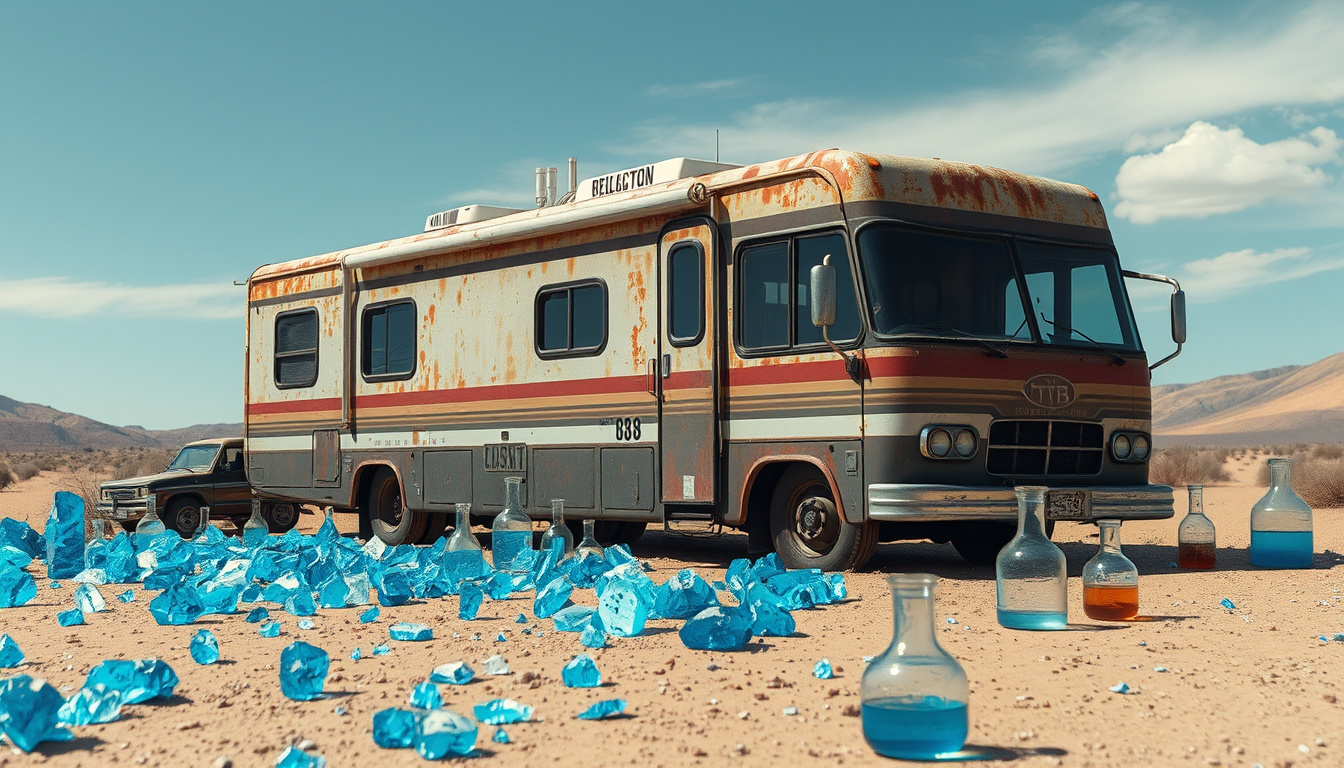
- Many viewers assume the RV (the “Breaking Bad RV”) is still around—it was actually destroyed for the show after filming wrapped, according to Wikiwand.
- Some fans believe the series is based on a real drug lord, but that is a myth — the story is entirely original.
Is Breaking Bad Based on a True Story?
No, Breaking Bad is entirely fictional. The characters, events, and even the blue meth element are inventions of creator Vince Gilligan and his writing team. The show does, however, reflect realistic drug trade dynamics, thanks to extensive research and consultation.
What to watch after Breaking Bad
If Breaking Bad is your first entry into the “antihero” genre, you have a rich backlog to explore. The most obvious recommendation is Better Call Saul, its slower-burning sibling series, which explores the tragedy of Jimmy McGill. For something with a similar moral descent, The Wire and Mad Men are both considered peers. If you want something more recent, Ozark follows a similar “normal person descends into crime” arc, though it lacks the same sense of humor.
For a completely different vibe but the same visual polish, check out The Night Of or True Detective (season 1). And if you simply want more of Walter White, there’s El Camino—though it’s best watched after the series wraps up.
Where the show ranks today: critic consensus
Reviews remain overwhelmingly positive. The series holds a 96% approval rating on Rotten Tomatoes, and the final season has a perfect 100% Critics Consensus. Its IMDb user rating of 9.5/10 places it as the #1 scripted live-action TV series on that platform (as of 2025). Critics often praise specific episodes like “Ozymandias” as some of the finest hours of television ever made.
The show’s legacy is also reflected in award records. It received 58 Primetime Emmy nominations in total, with 16 wins, including Outstanding Drama Series twice. Bryan Cranston and Aaron Paul both remained critical darlings post-show, and Gilligan’s production company has continued to produce acclaimed projects like Better Call Saul.
Is Breaking Bad a Hit or Flop?
Breaking Bad was a massive commercial and critical hit, with ratings rising steadily from season 1 to its final season. The show won numerous awards, including 16 Primetime Emmys and two Golden Globes. It has been listed on many “greatest TV shows of all time” lists, including Rolling Stone and Entertainment Weekly.
- Exceptional writing and character arcs
- Career-defining performances
- Groundbreaking cinematography
- Slow start in the first season may deter some viewers
- Intense violence and moral ambiguity not for everyone
Warning: The series contains graphic violence and mature themes. Viewer discretion advised.
criticker.com, metacritic.com, metacritic.com, imdb.com, metacritic.com, en.wikipedia.org, thetvdb.com, pluggedin.com, in.ign.com
Frequently asked questions about Breaking Bad
Is Breaking Bad based on a true story?
No, Breaking Bad is entirely fictional. The characters, events, and even the blue meth element are inventions of creator Vince Gilligan and his writing team. The show does, however, reflect realistic drug trade dynamics, thanks to extensive research and consultation.
How many seasons of Breaking Bad are there?
There are five seasons, running from 2008 to 2013, totaling 62 episodes. The final season was split into two parts, with the second part airing in 2013.
Is Breaking Bad worth watching in 2025?
Absolutely. The show’s themes of pride, consequence, and deterioration are timeless. Its writing, acting, and cinematography have aged exceptionally well, and it remains the benchmark for serialized drama.
What is the correct order to watch Breaking Bad and its spin-offs?
The release order is the simplest: Breaking Bad (2008–2013), then El Camino (2019), then Better Call Saul (2015–2022). For first-time viewers, stop after Breaking Bad before moving on to avoid minor spoilers for the spin-offs.
Are there any spin-offs from Breaking Bad?
Yes. The most significant is Better Call Saul, a prequel series focusing on lawyer Saul Goodman. There’s also El Camino, a film that follows Jesse Pinkman immediately after the series finale. Both are widely praised by critics.
What does “Breaking Bad” actually mean?
The title is a Southern American idiom meaning “to raise hell” or “to go off the rails.” Creative sources confirm Gilligan chose it to reflect Walter White’s journey from law-abiding citizen to criminal mastermind.
Did Walter White die at the end?
Warning: spoilers ahead. The series finale “Felina” shows Walt dying from a gunshot wound in a meth lab. The film El Camino continues Jesse’s story, but Walter’s fate is considered closed.
Which episode should I start with?
If you’re just sampling, start with season 1, episode 1, “Pilot.” But to truly understand why Breaking Bad is special, commit to at least the first two seasons. It’s a show that rewards patience—and once the first big twist hits, you won’t be able to stop.
Related reading
Interested in more? Check out Wikiwand’s deep dive into Breaking Bad for an extensive episode guide and production history. For critical analysis, Rolling Stone’s list puts it at #1 of all time — a claim that’s hard to argue with once you’ve finished the journey.
Related stories





Daniel Campbell is Editor-in-Chief at True North Brief, overseeing editorial standards, publication decisions and corrections.