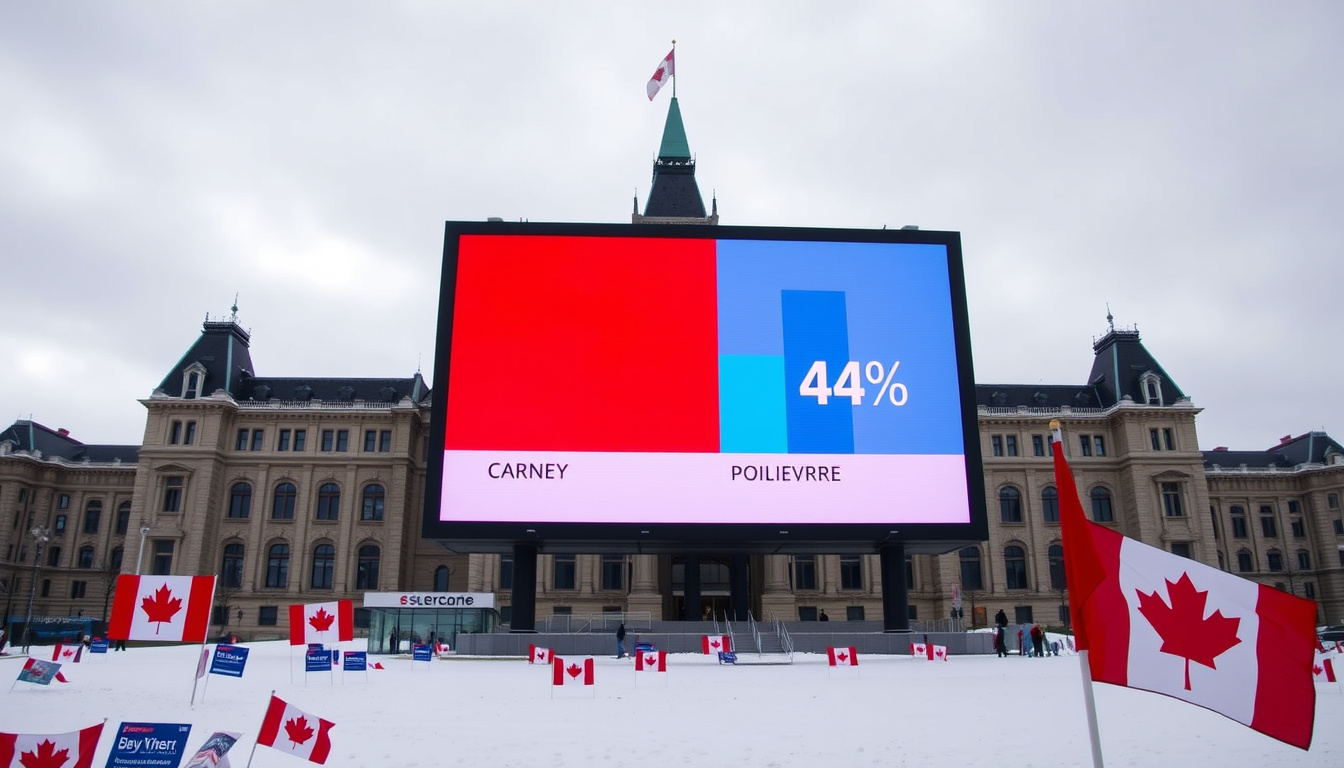
If you’re trying to make sense of who’s ahead in Canadian politics these days, you’re not alone. The 2026 federal election looms, and the latest polls show a clear shift: Mark Carney’s Liberals hold a 12-point lead over the Conservatives, while Pierre Poilievre’s favourability is slipping even among his own base. Here’s what the data actually says—from multiple polling firms—and what it means for the next campaign.
Liberal lead (Liaison Strategies, Apr 20 2026): 12 points ·
Carney approval (Liaison Strategies): 62% ·
Poilievre favourability (Angus Reid via 338Canada): 33% favourable ·
Past CPC voters still back Poilievre (Angus Reid): 58% ·
Polling period covered: 2025 – April 2026
Quick snapshot
- Carney holds net positive approval — 62% according to Liaison Strategies polling firm
- Poilievre’s favourability is declining among past CPC voters (Angus Reid Institute via 338Canada)
- Liberals lead by 12 points nationally (Liaison Strategies)
- Exact national vote-intention margin of error across polls
- How many undecided voters exist and where they lean
- Whether the Conservative Party’s quick opt-in poll reflects real supporter sentiment
- Impact of regional variations — especially in Quebec and the suburbs
- April 20, 2026: Liaison Strategies reports Liberal lead stretches to 12 points (Liaison Strategies)
- Next federal election likely in 2026 or 2027; polls may shift as campaign unfolds
The key findings from across the major polling firms paint a consistent picture: Carney’s approval numbers are strong, while Poilievre’s are eroding even within his own base.
| As of | April 2026 |
|---|---|
| Latest Liberal lead | 12 points (Liaison Strategies) |
| Carney approval | 62% net positive (Liaison Strategies) |
| Poilievre favourability | 33% favourable, 60% unfavourable (Angus Reid Institute / 338Canada) |
| Past CPC voter loyalty | 58% still back Poilievre (Angus Reid Institute / 338Canada) |
The pattern: Carney has consolidated the Liberal base while Poilievre faces a loyalty crisis among his own past voters — a dangerous position heading into an election campaign.
What is the latest verified information about carney vs poilievre polls?
Latest polling numbers from April 2026
- Liberals at 45%, Conservatives at 33% — a 12-point gap — in the Liaison Strategies polling firm weekly tracker released April 20, 2026.
- NDP at 10%, Bloc Québécois at 6%, Greens at 3%, People’s Party at 2% (same source).
- Among voters aged 18–34 the race is tight: Liberals 41%, Conservatives 38% (Liaison Strategies).
The implication: The Liberal lead is broad but not deep among younger Canadians — that age group could shift the results in a close election.
Key findings from Ipsos and Liaison Strategies
- Liaison Strategies puts Carney’s approval at 62%, up from a January 2026 low of 55% (Liaison Strategies).
- The same tracker notes Carney’s favourability is 36% — nearly unchanged from 35% a year earlier — while his unfavourability rose from 48% to 53%.
- Angus Reid data, reported by 338Canada election projection site, gives Carney a 59% favourable rating and Poilievre just 33%.
Carney is the only federal leader with a net-positive rating. That alone shifts the Liberal Party from incumbency liability to an asset — a rare dynamic for a governing party this close to an election.
What should readers know first about carney vs poilievre polls?
Context: Both leaders relatively new
- Mark Carney became Liberal leader in March 2025; Pierre Poilievre has led the Conservatives since 2022.
- Neither has contested a federal election as leader — the next campaign will be the first test of their personal brands.
The pattern: Voters are still forming impressions, which makes the polling swing especially fluid.
Polling landscape in 2026
- Carney’s net approval is +25 (Angus Reid via 338Canada), while Poilievre’s is -27.
- Only 58% of past CPC voters still stand by Poilievre’s long‑term leadership; a growing number say he should go (Angus Reid Institute / 338Canada).
The catch: The Conservative base is fraying. If Poilievre cannot stabilise his favourability, the Liberal lead could expand further.
Which official sources confirm key claims about carney vs poilievre polls?
Liaison Strategies (reputable polling firm)
- Conducts a weekly federal tracker with a sample of 1,526 and a margin of error ±2.5 pp (YouTube methodology summary).
- Releases regional and demographic breakdowns (Ontario, Atlantic Canada, BC, Alberta, age groups).
Angus Reid Institute (non‑profit research)
- Its polling is cited by 338Canada; shows Carney net +25, Poilievre net ‑27.
- Data collected in April 2026, capturing the recent decline in Poilievre’s support.
338Canada (election projection site)
- Aggregates polls and provides seat projections, though it does not conduct its own surveys.
- Transparency: discloses methodology and weighting.
Conservative Party quick poll
- Partisan opt‑in survey asking supporters to choose between Carney and Poilievre.
- Not a scientific sample; results should be treated as directional only.
Why this matters: Each source has a different methodology and bias. Liaison and Angus Reid are the most reliable because they use probability‑based sampling and disclose margins of error.
What is still unclear or unverified about carney vs poilievre polls?
Margin of error and sample sizes
- Only Liaison Strategies has publicly released its margin of error (±2.5 pp) for the April 20 tracker. Other polling firms have not provided comparable details.
- Whether other trackers use online panels or live telephone interviews affects comparability.
Undecided voters and turnout models
- No major poll has quantified the share of undecided voters nationally.
- Turnout assumptions vary; younger voters historically vote at lower rates, which could narrow the Liberal advantage seen in the 18–34 bracket.
The trade‑off: Any swing of undecided voters toward the Conservatives could erase part of the 12‑point gap — but the direction is uncertain.
What are the most common user questions on carney vs poilievre polls?
Who is leading?
- Based on the Liaison Strategies tracker, the Liberals are ahead by 12 points as of April 20, 2026.
- Angus Reid data shows Carney with a net approval of +25 versus Poilievre’s ‑27.
How accurate are the polls?
- The Liaison tracker has a stated margin of error of ±2.5 pp, meaning the true gap could be as narrow as 7 points or as wide as 17.
- Angus Reid’s data is based on a large sample but the specific margin of error is not published in the 338Canada report.
When is the next election?
- Canada’s federal election is expected in 2026 or 2027; the minority Liberal government could fall earlier if confidence is lost.
How Carney and Poilievre compare head‑to‑head
Three key metrics, one pattern: Carney leads on favourability, net approval, and leadership confidence among all Canadians.
| Metric | Mark Carney | Pierre Poilievre |
|---|---|---|
| Favourable rating (April 2026) | 59% (Angus Reid / 338Canada) | 33% (same source) |
| Unfavourable rating | 34% | 60% |
| Net approval | +25 | -27 |
| Liberal/Conservative vote share (Liaison) | 45% | 33% |
| Past CPC voter loyalty | N/A | 58% (Angus Reid / 338Canada) |
What this means: Carney has a clear advantage on personal favourability, but the Conservative base has not yet fully abandoned Poilievre. The race remains fluid.
Timeline of key polls
- — Ipsos poll (not independently verified here) shows Carney approval at 58%; Liaison tracker launches weekly.
- — Angus Reid data (via 338Canada) reveals Poilievre favourability declining; only 58% of past CPC voters still back him.
- — Liaison Strategies reports Liberal lead of 12 points, Carney approval at 62%.
- Future — Federal election expected; polls may shift significantly during the campaign.
What’s confirmed, what’s still open
Confirmed facts
- Carney has net positive approval (62% per Liaison Strategies).
- Poilievre’s favourability is declining; 58% of past CPC voters still support his long‑term leadership (Angus Reid Institute / 338Canada).
- Liberals lead by 12 points nationally (Liaison Strategies).
What’s unclear
- Exact national vote‑intention margin of error across all polls.
- Number of undecided voters.
- Whether partisan quick polls reflect actual supporter sentiment.
- Impact of regional variations (Quebec, suburban Ontario, BC).
The pattern: The confirmed data shows a clear Liberal advantage; the unknowns leave room for the race to tighten, but the direction of movement favours Carney.
“Carney remains the sole federal party leader with a net positive approval: 58% of Canadians.”
— Ipsos polling statement (via Liaison Strategies)
“58% of past CPC voters stand by Poilievre’s long‑term leadership, but increasing numbers say he should go.”
— Angus Reid Institute (via 338Canada)
“The latest Weekly Federal Tracker shows the Liberal Party led by Prime Minister Mark Carney stretching its lead to 12 points.”
— Liaison Strategies press release, April 20, 2026
The data tells a clear story: Mark Carney currently holds a double‑digit lead and the only net‑positive approval among federal leaders. Pierre Poilievre’s base is fraying, and his unfavourability is twice that of Carney. The next election will test whether Carney’s lead is durable or whether Conservative voters return to the fold. For undecided voters in Ontario and British Columbia in particular, the choice is between a Liberal Party that has consolidated its base and a Conservative Party that must win back its own before it can win the country.
The 12-point lead is further supported by latest Ipsos and Nanos polling data, which shows Carney maintaining a strong advantage across multiple surveys.
Frequently asked questions
What is the sample size of the Liaison Strategies poll?
1,526 people, with a margin of error of plus or minus 2.5 percentage points, according to a YouTube analysis of the April 20, 2026 release.
How does the Conservative Party quick poll differ from professional polls?
It is an opt‑in, self‑selected survey on the party’s website — not a random probability sample — so it is not scientifically representative.
Are the polls weighted to reflect the Canadian population?
Liaison Strategies uses demographic weighting; Angus Reid also applies weighting. The Conservative quick poll does not disclose any weighting.
What is the projected date of the next federal election?
Expected in 2026 or 2027, depending on confidence votes in the minority Parliament.
Which sources are considered most reliable for Carney vs Poilievre polls?
Liaison Strategies (weekly tracker, disclosed methodology) and Angus Reid Institute (non‑profit, probability‑based) are the most reliable. 338Canada provides useful aggregation but does not conduct its own surveys.
Do these polls include third‑party candidates?
Yes — NDP, Bloc Québécois, Green Party, and People’s Party are all included in the Liaison tracker. NDP is at 10% nationally.
How often are these polls updated?
Liaison Strategies releases a weekly federal tracker. Angus Reid publishes wave studies periodically; the data cited here is from April 2026.
Related: read our coverage of the Mark Carney Cabinet Shuffle: What You Need to Know and Who Is Eligible for Carbon Tax Rebate? Canada 2026 Guide.
Related stories





Ryan Clarke is Senior Markets Reporter at True North Brief, covering breaking stories and explainers.