
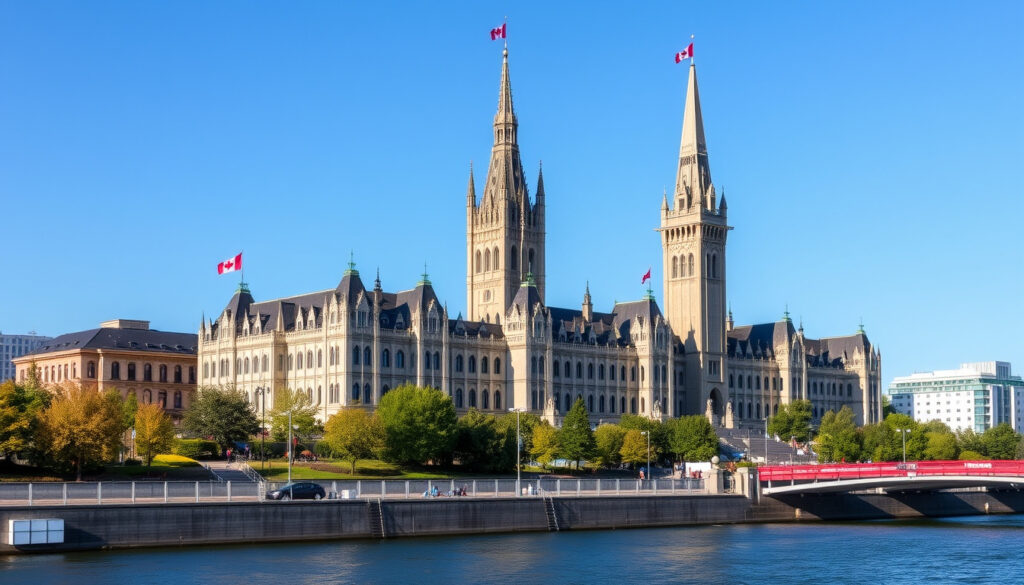
Canada’s capital city is Ottawa, a position it has held since 1857 when Queen Victoria selected it as the seat of government for the United Province of Canada. Located in southeastern Ontario along the Ottawa River, the city sits directly across the waterway from Gatineau, Quebec, forming part of the National Capital Region that spans both provinces. Unlike some nations where capitals were established centuries ago, Ottawa’s selection came through a deliberate political process aimed at balancing competing regional interests between English and French-speaking populations.
For many visitors and even some Canadians, the choice of Ottawa may come as a surprise. The city is neither the largest in the country nor the most internationally recognized, with Toronto and Montreal often drawing more global attention. Yet its geographic position, nestled between the country’s two main linguistic communities, made it an ideal compromise that satisfied neither fully but united both under one administrative centre.
What is the Capital of Canada?
Ottawa serves as the capital of Canada, functioning as the centre of the federal government’s operations. The city is home to Parliament Hill, where the Senate, House of Commons, and the administrative offices of federal ministries are located. As the political hub of the nation, Ottawa hosts ceremonial events, diplomatic functions, and the day-to-day governance that sustains the country’s operations.
- City: Ottawa
- Province: Ontario
- Location: South bank of the Ottawa River
- Status: Federal capital since December 31, 1857
Key Insights About Canada’s Capital
Several factors distinguish Ottawa as Canada’s capital and explain its selection over larger competitors:
- Ottawa was chosen specifically because of its neutral position between Canada West (Ontario) and Canada East (Quebec), serving as a compromise between the country’s two dominant linguistic regions.
- The city’s location on elevated terrain above the Ottawa River provided defensive advantages that rival cities lacked, particularly in an era of border uncertainties.
- The surrounding dense forest created a natural barrier that further enhanced the city’s security profile.
- Despite being a relatively small lumber town at the time of selection, Ottawa was centrally positioned between Toronto and Quebec City.
- The National Capital Region encompasses municipalities on both sides of the Ottawa River, including Gatineau in Quebec, creating a bilingual administrative zone.
- The Rideau Canal, constructed for military defense purposes, had established Ottawa’s importance as an early settlement long before it became the capital.
| Fact | Detail |
|---|---|
| Capital City | Ottawa |
| Province | Ontario |
| Neighboring Municipality | Gatineau, Quebec |
| Government Seat | Parliament Hill |
| Original Name | Bytown (1826) |
| Renamed | Ottawa (1855) |
| Capital Selection Date | December 31, 1857 |
| Functional Capital | 1866 |
Where is the Capital of Canada Located?
Ottawa is situated in eastern Ontario on the south bank of the Ottawa River, which serves as the natural border between Ontario and Quebec. The city’s coordinates place it approximately 450 kilometres northeast of Toronto and roughly 200 kilometres northwest of Montreal. This positioning makes it accessible from major population centres while maintaining sufficient distance from the United States border to address 19th-century security concerns.
The National Capital Region extends across both provinces, incorporating Ottawa and surrounding municipalities in Ontario alongside Gatineau and its neighbouring communities in Quebec. This cross-provincial arrangement creates a uniquely bilingual administrative zone where federal institutions operate in both English and French. The region was deliberately designed to reflect Canada’s dual heritage and serves as a symbol of national unity despite its geographic division.
Originally founded as Bytown in 1826, the settlement developed around the lumber trade and the construction of the Rideau Canal. The canal, built under the direction of Lieutenant Colonel John By for military purposes following the War of 1812, connected the Ottawa River to Lake Ontario and established the community’s strategic importance. The settlement was officially renamed Ottawa in 1855 and incorporated five years later, with subsequent annexations expanding its boundaries over time.
The Selection Process and Geographic Considerations
The choice of Ottawa as capital resulted from over 200 parliamentary votes conducted over several years, with 48 votes occurring in 1856 alone. Politicians from Ottawa and Montreal led efforts to end what contemporaries called the “perambulating system,” whereby the capital shifted between cities every few years. This instability hindered efficient governance and created logistical challenges for the provincial administration.
Governor General Edmund Head and the Colonial Office recommended Ottawa based on several geographic advantages. The city’s elevated position on a cliff above the Ottawa River offered natural defensive capabilities that lower-lying cities could not match. Its isolation from the United States border reduced vulnerability to potential incursions during periods of diplomatic tension. Furthermore, its location straddling the boundary between Canada West and Canada East made it symbolically acceptable to both linguistic communities.
The National Capital Region is a federally designated area spanning both Ontario and Quebec. It includes Ottawa, Gatineau, and surrounding municipalities, operating as a bilingual administrative district for federal purposes. Visitors planning trips should note that federal attractions and services are available in both official languages throughout the region.
What is the Capital of Ontario?
A common source of confusion involves mixing Canada’s national capital with provincial administrative centres. The capital of Ontario is not Ottawa but rather Toronto, which has served as Ontario’s provincial capital since 1867. This distinction matters because Ontario is Canada’s most populous province and hosts both the national capital in Ottawa and its own provincial seat of government in Toronto.
Toronto’s selection as Ontario’s capital occurred following Confederation and reflected the city’s growing importance as a commercial and transportation hub. The city had previously served as a temporary capital for the Province of Canada during two separate periods (1849-1851 and 1855-1859), demonstrating its established role in provincial affairs even before becoming Ontario’s permanent capital.
Provincial Capitals Across Canada
Each Canadian province and territory maintains its own capital city separate from the national capital. Quebec’s capital is Quebec City, British Columbia’s is Victoria, Alberta’s is Edmonton, and so forth. This system means that Canada has fourteen distinct capital cities at various governmental levels, with Ottawa serving as the sole national capital. Understanding this distinction helps clarify the unique status that Ottawa holds in the Canadian governmental hierarchy.
Is Toronto or Quebec the Capital of Canada?
Neither Toronto nor Quebec City serves as Canada’s capital, though both cities frequently appear in common misconceptions. Toronto has never held the position of national capital, despite being Canada’s largest city by population and a major economic centre. Quebec City, meanwhile, served as the capital of New France during the colonial era and later as a capital for the Province of Canada between 1851 and 1855, but never became Canada’s capital after Confederation.
The misconception that Toronto might be Canada’s capital likely stems from its prominence in international perception. As the country’s most populous metropolitan area and home to major financial institutions, media outlets, and cultural venues, Toronto often dominates media coverage. Visitors researching Canadian geography from abroad may assume that the most prominent city must be the capital.
Ottawa is definitively Canada’s capital—it is not located in Quebec despite sitting directly across the Ottawa River from the province of Quebec. The city was chosen before Confederation in 1857 and confirmed as the national capital upon Confederation in 1867. Neither Toronto nor Quebec City has ever held this status.
Similarly, Quebec City’s association with Canada’s capital often relates to its historical significance as a European colonial centre and its position as Quebec’s provincial capital. The city’s prominence in the French-speaking world and its role in provincial governance can create confusion about its national status. However, Quebec City represents only Quebec within Canada’s federal system, not the entire nation.
Why the Confusion Exists
Several factors contribute to persistent confusion about Canada’s capital. The selection of Ottawa was controversial at the time, with many expecting larger cities like Montreal or Toronto to receive the designation. A small lumber town suddenly becoming a national capital defied expectations, and the choice required parliamentary ratification in 1859 that passed by a narrow margin—three votes either way would have overturned the decision.
George Brown, a prominent political figure, unsuccessfully attempted to reverse the selection after ratification. The surprise element persists today because Ottawa lacks the international recognition of Toronto or Montreal, making it an unexpected answer for those unfamiliar with Canadian political history.
What is the Capital of Ottawa?
This question contains a logical inversion—Ottawa is the capital, not a location that has its own capital. The proper framing asks what federal functions Ottawa hosts or what institutions serve as the city’s administrative centre. In this context, Parliament Hill serves as the symbolic and functional heart of Canada’s federal government, housing the legislative chambers and administrative offices that coordinate national affairs.
The Gothic Revival Parliament Buildings, constructed following the 1857 selection, began hosting sessions in 1866 and remain the most recognizable symbols of Canadian governance. These structures, situated atop the escarpment overlooking the Ottawa River, have witnessed every major decision in Canadian history from Confederation through contemporary times.
Name Origin and Pronunciation
The name “Ottawa” derives from the Algonquin word “adawe,” meaning “to trade,” reflecting the city’s origins as a trading post where Indigenous peoples and European settlers conducted commerce. This linguistic heritage connects the capital to the continent’s original inhabitants and acknowledges the role of Indigenous trade networks in shaping the region’s development. Natural Resources Canada maintains comprehensive records on Canadian place name origins that document this linguistic connection.
The pronunciation in English follows the pattern “OT-uh-wuh” with emphasis placed on the first syllable. The phonetic representation /ˈɒtəwə/ indicates a relaxed vowel in the second syllable, producing a sound closer to “OT-tuh-wuh” in casual speech. French pronunciation differs, maintaining a more Francophone character consistent with Quebec’s linguistic influence on the region.
Historical Timeline of Capital Selection
The selection of Canada’s capital followed decades of instability as the Province of Canada searched for a permanent seat of government. Before Confederation, capitals shifted numerous times due to competing regional interests:
- 1841: Kingston becomes the capital following the union of Upper and Lower Canada.
- 1844: Montreal selected after renovations to St. Anne’s Market provided suitable government facilities.
- 1849-1851: Toronto serves as capital during this period.
- 1851-1855: Quebec City hosts the provincial government.
- 1855-1859: Toronto regains the capital position.
- 1859-1865: Quebec City serves as interim capital following ratification of the Ottawa selection.
- 1857: Queen Victoria chooses Ottawa as the permanent capital, effective December 31.
- 1865-1866: Parliament relocates to the newly constructed buildings in Ottawa.
- 1866: Ottawa becomes the functional legislative capital.
- 1867: Confederation confirms Ottawa as the capital of the new Dominion of Canada.
The parliamentary process to select a permanent capital involved extensive debate and multiple votes, reflecting the difficulty of reaching consensus among politicians representing diverse regional interests. The eventual choice of Ottawa represented a compromise that satisfied no faction completely but proved acceptable to enough members to secure ratification.
What is Known and What Remains Unclear
Canada’s capital designation rests on solid historical documentation, though some aspects of the period remain subject to scholarly inquiry:
| Established Information | Information Requiring Further Clarity |
|---|---|
| Queen Victoria selected Ottawa on December 31, 1857 | Specific details of the private deliberations between the Colonial Office and Governor General Head |
| The selection required parliamentary ratification in 1859 | The extent of lobbying by Ottawa’s advocates compared to other cities |
| Ottawa became the functional capital in 1866 | Precise motivations of individual parliamentarians who voted for Ottawa |
| Confederation confirmed Ottawa’s status in 1867 | The role of defence considerations versus symbolic compromise in the final decision |
| The city was recommended for its geographic position and defensibility | Whether alternative sites were formally considered beyond the major cities |
Primary sources including parliamentary records, government documents from the City of Ottawa, and accounts from the Historical Society of Ottawa provide detailed documentation of the capital selection process. The narrow ratification vote (three votes either way would have changed the outcome) is well-documented in these sources.
Why Ottawa Was Selected
The selection of Ottawa as Canada’s capital reflected practical considerations rather than romantic notions about national symbolism. In the mid-19th century, Canada faced challenges that influenced governmental structure, including regional tensions between English and French populations, concerns about border security with the United States, and the practical need for a permanent administrative centre.
Governor General Edmund Head, advised by the Colonial Office, recommended Ottawa specifically because the city offered a balance between competing interests. Its position straddling the boundary between Canada West and Canada East made it symbolically meaningful to both linguistic communities. The city was neither perceived as “too western” (like Toronto) nor “too eastern” (like Quebec City), creating a genuinely neutral ground. Official government records from the City of Ottawa archives document these deliberations in detail.
Defensive considerations also played a significant role. The elevated position above the Ottawa River and the surrounding dense forest provided natural protection against potential military threats. At a time when relations with the United States remained uncertain following the War of 1812 and subsequent border incidents, choosing a location with inherent defensive advantages made strategic sense.
Despite its small size and modest profile, Ottawa had developed sufficient infrastructure through the lumber trade and the Rideau Canal to support governmental functions. The settlement at the canal’s mouth, equidistant from major population centres, had established itself as a regional hub capable of expansion.
Sources and Official Documentation
Queen Victoria was pleased to comply with the recommendation that Ottawa should be the capital of the United Province of Canada, and the city was accordingly selected on December 31, 1857.
— City of Ottawa historical records, documents.ottawa.ca
The official documentation surrounding Ottawa’s selection as capital draws from multiple authoritative sources. City of Ottawa archives maintain records of the municipal records pertaining to the capital decision, while the Historical Society of Ottawa has documented the events through various publications examining the decision-making process. These sources collectively provide a comprehensive picture of the political circumstances surrounding the selection.
Encyclopedic sources including the Encyclopaedia Britannica and Wikipedia provide accessible summaries of Canadian capital history. The Historical Society of Ottawa offers primary documentation of the period through their published materials and archival collections.
Travel and educational resources like Bright Spark Travel provide narrative explanations of the capital selection process suitable for general audiences seeking to understand this historical period.
Summary
Canada’s capital is Ottawa, a city located in Ontario along the Ottawa River directly across from Gatineau, Quebec. Queen Victoria selected it on December 31, 1857, after years of parliamentary debate, choosing it for its defensive position, central location between competing regions, and symbolic balance between English and French Canada. The city became the functional legislative capital in 1866 and was confirmed as the national capital upon Confederation in 1867.
Those planning visits to the region might find the St. Laurent Shopping Centre Directory useful for exploring local attractions. While Toronto serves as the capital of Ontario and Quebec City serves as the capital of Quebec, only Ottawa represents the entire nation as its federal capital.
Frequently Asked Questions
Is Ottawa the capital of Canada?
Yes, Ottawa has been Canada’s capital since 1857 when Queen Victoria selected it, and this status was confirmed upon Confederation in 1867.
What is the capital of Ontario?
Toronto is the capital of Ontario, not Ottawa. Ontario is one of Canada’s provinces, each with its own provincial capital distinct from the national capital.
Is Quebec the capital of Canada?
No, Quebec City is the capital of the province of Quebec, not Canada. Quebec has never served as Canada’s national capital.
How do you pronounce Ottawa?
Ottawa is pronounced “OT-uh-wuh” in English with emphasis on the first syllable, derived from the Algonquin word meaning “to trade.”
Why was Ottawa chosen as Canada’s capital?
Ottawa was chosen for its neutral position between English and French Canada, its defensible location on elevated terrain, and its central geographic location between Toronto and Quebec City.
What cities was Ottawa chosen over?
Ottawa was selected over Toronto, Quebec City, Montreal, and Kingston, which had each served as temporary capitals during the perambulating period before 1857.
Where is Parliament Hill located?
Parliament Hill is located in Ottawa, Ontario, on the south bank of the Ottawa River, overlooking the river and across from Gatineau, Quebec.
Related stories



Michael Foster covers Canadian markets, the TSX and commodity trends for True North Brief.