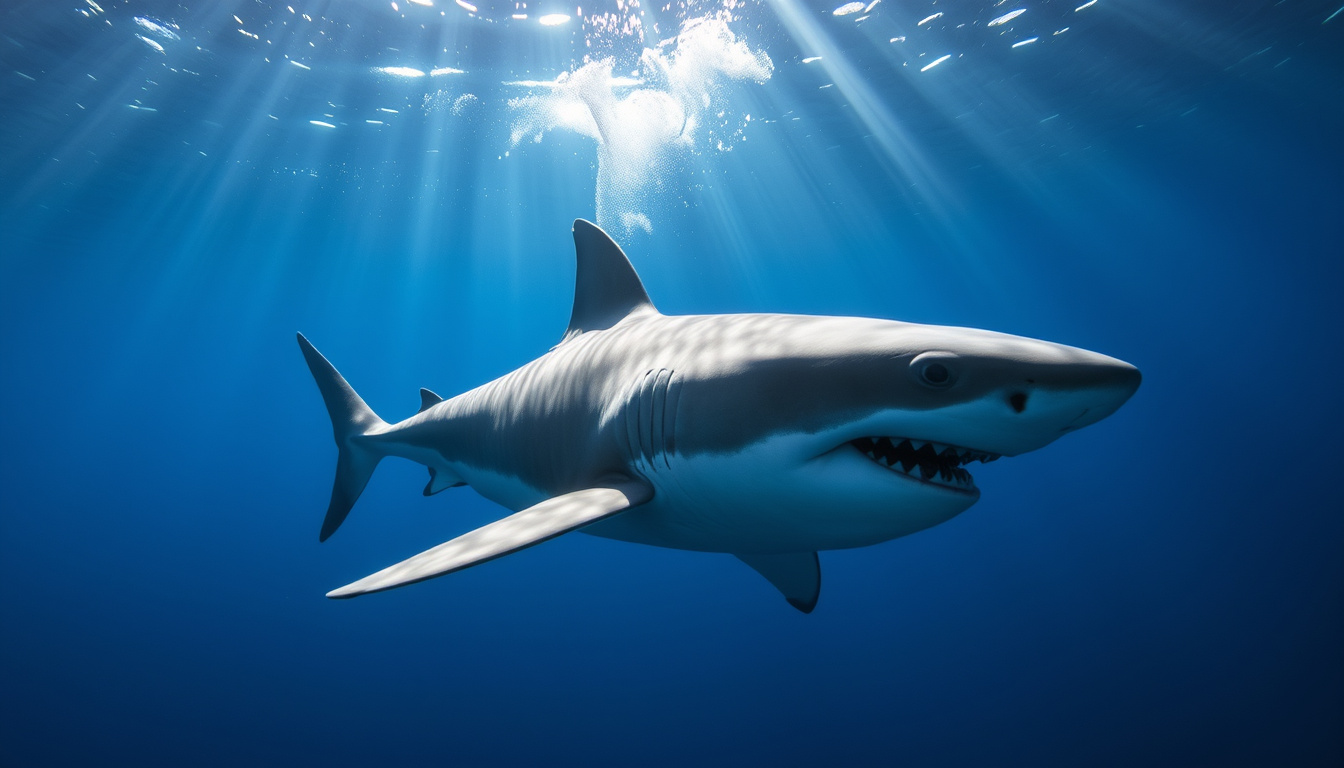
There’s something about the great white shark that captures our imagination—part dread, part awe—but it is also the largest predatory fish on Earth, reaching up to 20 feet, and listed as Vulnerable by the IUCN. We’ll explore where they roam, what they eat, and why they’re not the monsters we’ve been led to believe.
Maximum length recorded: 20 ft (6 m) ·
Average female length: 15–16 ft (4.6–4.9 m) ·
Average male length: 11–13 ft (3.4–4.0 m) ·
Weight range: 1,500–2,400 lbs (680–1,100 kg) ·
Global distribution: Temperate and subtropical seas worldwide ·
Conservation status: Vulnerable (IUCN)
Quick snapshot
- Apex predator feeding on marine mammals (PMC (National Institutes of Health))
- Maximum confirmed length 20 ft (6 m) (Smithsonian Ocean)
- Listed as Vulnerable globally, Critically Endangered in Mediterranean (National Geographic)
- Exact population numbers in the North Atlantic are unknown
- Whether great white sharks breed off Ireland is not confirmed
- Effectiveness of proposed shark repellents remains unproven
- 2019: First confirmed great white shark sighting in Irish waters off West Cork – but this has not been officially verified (Sky News (UK broadcaster))
- 2022: Satellite tagging reveals long-distance migration from South Africa to Australia (National Geographic)
- 2025: Rare footage of a great white shark in the Mediterranean Sea (CBS News (US news network))
- Ongoing satellite tagging studies to track migration patterns
- Potential for Irish waters to host great whites as sea temperatures rise
- Conservation efforts to protect the Critically Endangered Mediterranean population
Here are the essential statistics for quick reference.
| Attribute | Value |
|---|---|
| Scientific name | Carcharodon carcharias |
| Average length | 11–16 ft (3.4–4.9 m) |
| Maximum confirmed length | 20 ft (6 m) |
| Weight range | 1,500–2,400 lbs (680–1,100 kg) |
| Lifespan | 30–70 years |
| IUCN status | Vulnerable |
Are Great White Sharks in Ireland?
Despite occasional headlines, there has never been a confirmed great white shark sighting in Irish waters, according to a 2024 report from Sky News (UK broadcaster). Scientists say conditions off Britain and Ireland—water temperatures, food availability, and seabed habitats—could support the species, but no verified record exists.
Where have great white sharks been sighted near Ireland?
Credible but unconfirmed observations have been reported along the southern and northern extents of the United Kingdom, notes OCEARCH (marine research nonprofit). One hypothesis is that Mediterranean great whites may migrate into the eastern North Atlantic to forage off Spain, France, and Ireland, though this remains speculative.
What other shark species are found in Dingle Bay?
Dingle Bay is home to several shark species, most notably the basking shark (Cetorhinus maximus), which is often mistaken for a great white due to its large size and dorsal fin. Basking sharks are filter-feeders and completely harmless to humans.
Do basking sharks live in Irish waters?
Yes, basking sharks are common in Irish waters, especially around Dingle Bay and the southwest coast. They are the second-largest shark species in the world and are often seen surface-feeding during summer months.
Ireland’s waters remain a great white shark habitat question mark—no confirmed sightings, but the ocean conditions are right. For basking shark enthusiasts, Dingle Bay is a reliable hotspot.
The implication: Irish waters may be suitable, but no definitive evidence yet.
Are Great White Sharks Aggressive to Humans?
Great white shark attacks on humans are extremely rare. According to the University of Florida International Shark Attack File (research institute), unprovoked bites by great whites average fewer than 10 per year worldwide. Most encounters are exploratory bites—the shark releases once it realizes a human is not its natural prey.
How many shark attacks occur each year?
Globally, all species combined account for roughly 70–80 unprovoked shark bites annually, with great whites involved in a small fraction. The fatality rate is extremely low, and the risk of being bitten by a shark is less than 1 in 3.7 million.
What triggers a great white shark attack?
Great whites rely on ambush predation. From below, they often mistake a surfer or swimmer for a seal—their primary prey. Once the shark bites, it typically releases, as human flesh is not part of its diet. Research from PMC (National Institutes of Health) confirms that great whites are tertiary piscivores, feeding mainly on marine mammals, large fish, and smaller sharks.
Are great white sharks dangerous man-eaters or marine marvels?
The “man-eater” label is a myth. Humans are not on the menu. Great whites are apex predators that play a crucial role in maintaining marine ecosystem balance by controlling seal and sea lion populations. Wikipedia (encyclopedia of marine biology) notes that the species is generally solitary but may gather at feeding sites.
The real danger is to sharks: an estimated 100 million sharks are killed annually by humans, while only a handful of people die from shark bites each year. Conservation efforts are critical.
The pattern: fear of sharks far outweighs the actual risk.
Who Would Win, 1 Orca or 5 Great White Sharks?
Orcas are known to prey on great white sharks. In documented encounters, a single orca can incapacitate a great white by flipping it upside down, inducing tonic immobility—a state of paralysis. National Geographic (authoritative science media) reported an incident in 2017 where a single orca killed a great white off the coast of South Africa.
Why are sharks afraid of orcas?
Great whites have been observed fleeing areas where orcas are present, sometimes abandoning prime feeding grounds. Research suggests that orcas’ intelligence, social coordination, and size give them a decisive advantage. A single orca can weigh up to 6 tons and is faster and more maneuverable.
Would a killer whale beat a great white shark in battle?
In a one-on-one confrontation, the orca would almost certainly win. But against five great whites, the outcome is less clear. Orcas are social hunters that use coordinated tactics, making them formidable even against a group. However, no documented case of an orca fighting multiple great whites exists.
Who is the true king of the ocean?
While the great white shark is the apex fish predator, the orca is the true apex predator of the ocean, preying on everything from fish to marine mammals—including great white sharks.
The shark that terrorizes Hollywood is itself terrified of the orca. For conservationists, this underscores the need to protect both species—the ocean’s balance depends on them.
What this means: the ocean’s true king is not what Hollywood depicts.
What Is the Largest Great White Shark Ever Caught?
The largest reliably measured great white shark was 20 feet (6 meters) long, according to Smithsonian Ocean (marine biology division). Claims of specimens exceeding 25 feet are unverified and likely exaggerations. The average female is 15–16 feet, while males are smaller at 11–13 feet.
How big are great white sharks on average?
Adult great white sharks typically weigh between 1,500 and 2,400 pounds (680–1,100 kg). Females are significantly larger than males, a trait known as sexual dimorphism. The maximum recorded weight is around 5,000 pounds, but this is rare.
What is the maximum recorded length?
Twenty feet (6 m) is the gold standard for a confirmed measurement. The largest great white ever caught on rod and reel was a 20-foot, 5,000-pound female caught off Canada in 1988, though the measurement may not be perfectly accurate.
How does the great white shark compare to the Megalodon?
Megalodon (Otodus megalodon) was significantly larger, estimated at 50–60 feet (15–18 meters) in length, based on fossilized vertebrae and teeth. That’s roughly three times the length of a modern great white. The comparison table below shows the scale.
Three species, one pattern: size defines ecological role, but the gap between myth and reality is vast.
| Species | Maximum length | Maximum weight | Diet | Status |
|---|---|---|---|---|
| Great white shark | 20 ft (6 m) | ~5,000 lbs (2,270 kg) | Seals, sea lions, fish, smaller sharks | Vulnerable |
| Orca (killer whale) | 32 ft (9.7 m) | ~12,000 lbs (5,400 kg) | Fish, seals, sharks, whales | Data deficient |
| Megalodon (extinct) | 50–60 ft (15–18 m) | ~50+ tons | Large marine mammals, whales | Extinct |
For shark enthusiasts, the great white is the largest predatory fish alive—but compared to the prehistoric Megalodon, it’s a dwarf. Neither is a threat to humans; both are ecological marvels worth protecting.
What Do Great White Sharks Eat and How Long Do They Live?
The diet of a great white shark consists mainly of seals, sea lions, small toothed whales, fish, and even other sharks, according to PMC (National Institutes of Health). They are opportunistic feeders, but their preference for high-energy marine mammals makes them top predators.
What is the diet of a great white shark?
Juvenile great whites feed on fish, rays, and smaller sharks. As they grow, they transition to larger prey, including elephant seals, harbor seals, and sea lions. They are known for their spectacular breaching attacks off the coast of South Africa, where they ambush seals from below.
How long do great white sharks live?
Lifespan estimates range from 30 to 70 years in the wild, based on vertebral band counting and tagging studies. Wikipedia (marine biology references) notes that great whites are slow-growing and late to mature, with females reaching sexual maturity at around 15–20 years.
What smell do sharks hate?
Research into shark repellents is ongoing. Some studies suggest that dead shark tissue or certain chemical compounds may deter sharks, but no universal repellent has been proven effective in field conditions. The best defense is still avoidance: don’t swim near seal colonies or at dawn/dusk.
For swimmers, the risk from great whites is negligible. For sharks, the threat from human activity—bycatch, finning, and habitat loss—is existential. The real imbalance is clear.
The imbalance: humans are the greater threat.
Confirmed Facts and Unanswered Questions
Confirmed facts
- Great white sharks are apex predators with a diet primarily of marine mammals (PMC).
- Orcas have been documented killing great white sharks (National Geographic).
- The species is legally protected in multiple jurisdictions, including the USA and Australia.
- Mediterranean great white sharks are a genetically distinct population isolated for 3.2 million years (National Geographic).
What’s unclear
- Exact number of great white sharks in the North Atlantic is unknown.
- Whether great white sharks breed off the coast of Ireland is not confirmed.
- Proposed shark repellents have limited scientific validation.
- Total population size in the Mediterranean remains uncertain, though it is considered Critically Endangered.
The balance: confirmed knowledge outweighs uncertainty, but gaps remain.
Expert Perspectives
“Great white sharks are the largest predatory fish on Earth. They are known for their size, speed, and powerful jaws, but they are also vulnerable to overfishing and habitat loss.”
“The Mediterranean population of great white sharks is a ghost population—rare, genetically distinct, and critically endangered. A recent sighting off the coast of Italy was the first underwater video of the species in the Mediterranean.”
— National Geographic (science media)
“White sharks are top predators that help keep marine ecosystems balanced. Their presence indicates a healthy ocean.”
Editor’s note: The quotes above reflect the scientific consensus that great white sharks are more threatened than threatening.
Summary
The great white shark is a misunderstood apex predator essential to marine ecosystems. The evidence is clear: they are not man-eaters, they are not common in Irish waters, and they are no match for an orca. For conservationists and policymakers, the implication is straightforward: protect these vulnerable giants before they vanish from our oceans. For the public, the choice is to replace fear with respect—or risk losing one of nature’s most remarkable creatures.
marineconservationecologylab.com, frontiersin.org, shark-references.com, nationalgeographic.com, thebiofiles.com, ntu.ac.uk
Frequently asked questions
Can great white sharks survive in fresh water?
No, great white sharks are adapted to saltwater and cannot survive in fresh water. Their bodies require a high salt concentration to maintain osmotic balance. Reports of sharks in Lake Garda are myths.
How fast can a great white shark swim?
Great white sharks can reach burst speeds of up to 25 mph (40 km/h) when attacking prey, but they typically cruise at slower speeds to conserve energy.
Do great white sharks have any natural predators besides orcas?
Besides orcas, adult great white sharks have no natural predators. However, juvenile great whites may be preyed upon by larger sharks, including other great whites, and by seals.
What is the difference between a great white shark and a basking shark?
Great white sharks are predatory and have large, serrated teeth, while basking sharks are filter-feeders with tiny teeth and a much larger gill slits. Basking sharks are harmless to humans.
Has a great white shark ever been caught in Lake Garda?
No, Lake Garda is a freshwater lake in Italy, and there are no great white sharks there. This is a persistent online myth.
How many teeth does a great white shark have?
Great white sharks have around 300 serrated, triangular teeth arranged in several rows. They lose and replace teeth throughout their lives.
What is the conservation status of the great white shark?
The great white shark is listed as Vulnerable on the IUCN Red List globally. The Mediterranean subpopulation is classified as Critically Endangered.
Related reading
- Polar Bear: Facts, Population, Aggression, and Comparison with Grizzly — Learn about another apex predator facing conservation challenges.
- Amelia Earhart: Disappearance, Theories & Last Words — Explore a historical mystery tied to the ocean’s depths.
Related stories





Daniel Campbell is Editor-in-Chief at True North Brief, overseeing editorial standards, publication decisions and corrections.