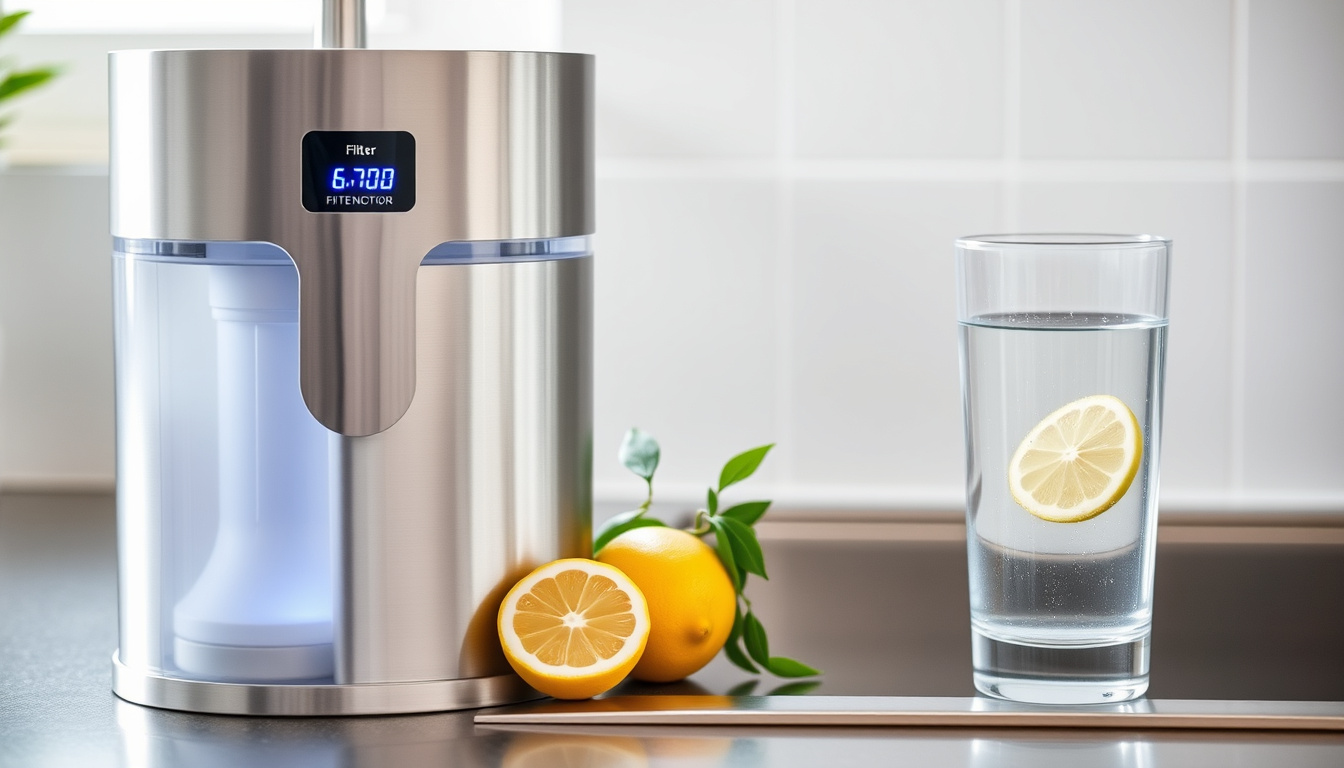

You know the moment — the kettle scales up in a week, the shower leaves your skin tight, and that faint chlorine smell hangs over the tap. For Irish homeowners, these aren’t just annoyances; they’re signs that your water supply carries hardness, chlorine, and sometimes bacteria. This guide cuts through the marketing to help you pick a water purifier system for your house that actually solves your local water problems, with real costs and science behind each choice.
Households in Ireland using water filters: approximately 30% (Irish Water, 2022) ·
Common contaminants in Irish tap water: hardness, chlorine, sediment, E. coli risk in private wells ·
NSF/ANSI standards for water filters: 42 (aesthetics), 53 (health), 58 (reverse osmosis), 62 (UV)
Quick snapshot
- Treats all water at point of entry
- Removes sediment, chlorine, some chemicals
- Typical cost: €500 – €3,000 installed (Juicers.ie)
- Filter replacement every 6-12 months
- Compact, fits under kitchen sink
- Uses RO or carbon filtration
- Cost: €150 – €800 (Consumer Reports)
- Produces drinking water only
- Portable, no installation
- Ideal for renters
- Cost: €50 – €300 (Consumer Reports)
- Limited flow rate
- Removes up to 99% of contaminants
- Requires 3:1 water waste ratio
- Strips minerals; may need remineralization
- Cost: €200 – €1,500 for whole house (Consumer Reports)
Each system type solves a different water problem at a different price point.
| Average cost of whole house system (Ireland) | €500 – €3,000 installed (Juicers.ie) |
|---|---|
| Common contaminants in Irish tap water | Hardness, chlorine, trihalomethanes, sediment; E. coli risk in private wells |
| NSF/ANSI standards relevant to home filters | 42 (aesthetics), 53 (health contaminants), 58 (reverse osmosis), 62 (UV disinfection) |
| Life expectancy of typical carbon block filter | 3–6 months |
| Annual maintenance cost (whole house) | €100 – €300 for replacement cartridges (Consumer Reports) |
What is the best water purifier system for home?
The answer depends on your water source. For Irish households on public mains, the top priority is usually chlorine and hardness. For private wells, bacteria and sediment take precedence. Consumer Reports (independent product testing lab) notes that whole-house systems vary from €500 to €3,000 installed, while under-sink units cost between €150 and €800. The best system is the one that matches your specific contaminant profile.
Top-rated whole house systems for 2026
- Aquasana Rhino EQ-600 – reduces up to 97% of chlorine for 600,000 gallons (Juicers.ie)
- Aquasana EQ-1000 – lasts up to 10 years, handles 1,000,000 gallons (Juicers.ie)
- iSpring Three-Stage – recommended for hard water (David Butler – Plumbing expert)
- Aqua-Pure – rated best overall by plumbing professionals (David Butler)
- Waterdrop G3 – easiest DIY install (David Butler)
Comparison of reverse osmosis, carbon, and UV technologies
- Activated carbon – improves taste, removes chlorine, sediment. Requires 3–6 month filter changes. Cost: €50–€300 annual.
- Reverse osmosis – removes up to 99% of dissolved solids including lead and arsenic. Wastes 3–5 gallons per gallon purified (Consumer Reports).
- UV disinfection – inactivates 99.99% of bacteria and viruses. Works best on clear water. No chemical residue.
Price ranges by system type
- Whole house carbon/RO: €500 – €3,000 installed
- Under-sink RO: €150 – €800
- Countertop: €50 – €300
- Water softener (ion exchange): €700 – €2,500+ (based on Irish supplier data: Celtic Water Solutions)
The pattern: whole-house systems give balanced protection but cost more upfront; point-of-use units are cheaper but don’t protect your pipes or appliances. The trade-off is convenience versus cost.
How do I choose a water purifier for my home?
Start by testing your water. The CDC (U.S. public health agency) recommends having water tested for hardness, pH, bacteria, and heavy metals before selecting a treatment. In Ireland, Irish Water provides annual reports for public supplies, but private well owners need independent testing.
Assess your source water quality
- Public mains: usually chlorinated, hard water (calcium/magnesium).
- Private wells: risk of E. coli, nitrates, sediment.
- Hardness test: if above 120 mg/L, consider a water softener.
Determine required filtration technology
- For chlorine/odour: activated carbon (NSF 42).
- For bacteria/cysts: UV or carbon with absolute micron rating ≤1 micron (NSF 53 or 58).
- For heavy metals/arsenic: reverse osmosis (NSF 58).
Check for NSF certifications
The Water Quality Association (industry body) states: “Whole house point-of-entry systems provide balanced water quality throughout the home.” The CDC adds: “Use filters certified by NSF International for the contaminants you want to reduce.”
Consider installation, maintenance, and budget
- Professional installation adds €200–€500 to whole-house systems.
- Annual maintenance (filter replacements) costs €100–€300 (Consumer Reports).
- Under-sink systems have lower installation costs but treat only drinking water.
The implication: skipping water testing is the most common mistake. Without knowing your specific contaminants, you risk buying a system that doesn’t solve your actual problem.
What is the downside of water purifiers?
Upsides
- Removes chlorine, sediment, lead, and bacteria – improves taste and health.
- Protects pipes and appliances from scale buildup.
- Reduces reliance on bottled water – saves money and plastic waste.
Downsides
- Reverse osmosis wastes 3–5 gallons of water per gallon purified (Consumer Reports).
- Replacement filters cost €86–€700 per year for whole-house systems (Consumer Reports).
- RO strips beneficial minerals like calcium and magnesium.
- Carbon filters must be replaced every 3–6 months to prevent bacterial growth.
The catch: the very technology that gives you pure water – reverse osmosis – also creates water waste and removes minerals. It’s a trade-off between purity and efficiency.
Why am I thirsty after drinking reverse osmosis water?
RO water has very low mineral content. The World Health Organization (health authority) notes that low-mineral water can cause an electrolyte imbalance. When you drink RO water, your body may try to balance mineral levels by releasing electrolytes, which triggers thirst.
Lack of electrolytes in RO water
- RO removes 90–99% of dissolved solids, including sodium, potassium, and magnesium.
- Without these electrolytes, water doesn’t hydrate as effectively.
pH balance and body hydration
- RO water is slightly acidic (pH ~6.5). Some argue this affects hydration, though evidence is thin.
How to remineralize RO water
- Add a remineralization stage to your system (carbon filter with calcium/mineral cartridge).
- Use mineral drops like Trace Minerals Research.
- Simply eat mineral-rich foods – the effect is usually minor for most people.
The trade-off: if thirst persists, consider adding an inline remineralizer. The slight extra cost improves the drinking experience significantly.
What is the best water filter for E. coli?
E. coli bacteria are about 0.5–2 microns. The CDC (U.S. public health agency) recommends filters with absolute pore size ≤1 micron for cyst reduction, but note that NSF/ANSI Standard 53 covers cryptosporidium and giardia, not all bacteria. For E. coli, UV is the gold standard.
How E. coli enters drinking water
- Private wells contaminated by septic runoff or livestock.
- Flooding or heavy rain can introduce bacteria.
NSF 53 and 58 certifications for cyst reduction
- NSF 53 covers cyst reduction – some carbon block filters achieve this.
- NSF 58 (RO) removes bacteria via membrane, but requires pre-filtration.
UV filtration as an alternative
- UV systems inactivate 99.99% of microorganisms without chemicals (Juicers.ie).
- Requires clear water – sediment must be pre-filtered.
Maintenance tips for E. coli filters
- UV bulbs need replacement every 12 months (cost ~€60–€100).
- Carbon pre-filters every 6 months.
- Boiling water is a temporary but effective method for killing E. coli.
Why this matters: for private well owners in rural Ireland, UV plus a sediment pre-filter is the most reliable solution. RO can also remove bacteria but wastes water and strips minerals.
If you’re on a well, don’t rely on carbon alone for bacteria. UV or RO with NSF 58 certification gives you a much higher safety margin.
System comparison: Which technology fits your home?
Four major filter technologies, three key dimensions – one pattern: each solves a different problem.
| Technology | Contaminants removed | Initial cost | Annual maintenance |
|---|---|---|---|
| Activated Carbon | Chlorine, sediment, bad taste | €50–€300 (countertop/cartridge) | €50–€150 |
| Reverse Osmosis | Arsenic, lead, nitrates, bacteria (with membrane) | €150–€1,500 | €80–€320 (Consumer Reports) |
| Ultraviolet (UV) | Bacteria, viruses, cysts | €200–€600 | €60–€150 (bulb + pre-filter) |
| Ion Exchange (Softener) | Hardness (calcium, magnesium) | €700–€2,500 (Celtic Water Solutions) | €100–€150 (salt) |
The pattern: if your water is hard, start with a softener. If you want clean drinking water, RO or carbon. If bacteria is a concern, UV is non-negotiable.
Step-by-step: Installing and maintaining a whole house system
- Step 1: Test your water – home test kits (€20–€40) or send a sample to a certified lab.
- Step 2: Choose the right system – match technology to contaminants (see table above).
- Step 3: Professional installation or DIY – whole-house systems need plumbing skills; under-sink kits can be DIY.
- Step 4: Install a bypass valve – allows you to switch raw water when changing filters.
- Step 5: Set a filter replacement schedule – carbon every 3–6 months, RO membrane every 2–3 years, UV bulb yearly.
Skipping regular filter changes leads to bacterial growth and reduced performance. Mark your calendar the day you install – it’s that easy to forget.
Confirmed facts
- Activated carbon filters reduce chlorine taste and odor.
- Reverse osmosis removes arsenic, lead, and nitrates with >90% efficiency.
- UV systems inactivate bacteria and viruses when water is clear.
- Aquasana Rhino EQ-600 reduces up to 97% of chlorine (Juicers.ie).
- Consumer Reports pitcher filters range $20–$140 (Consumer Reports).
What’s unclear
- Whether long-term consumption of demineralized RO water causes health issues.
- Optimal filter configuration for all possible local contaminants.
- Comparative performance of different brands under real-world Irish water conditions.
“Use filters certified by NSF International for the contaminants you want to reduce.”
– CDC Drinking Water Guidance
“Whole house point-of-entry systems provide balanced water quality throughout the home.”
– Water Quality Association
The bottom line for Irish homeowners: a water purifier system is an investment in health and comfort, but only if it matches your actual water chemistry. For hard water, a softener plus a point-of-use RO gives the best results. For well water, UV is non-negotiable. The choice is clear: test first, then buy – or risk wasting money on a system that solves the wrong problem.
For a detailed comparison tailored to Irish households, see our guide on the water purifier system for house in Ireland.
Frequently asked questions
How often should I replace the whole house water filter?
Carbon block filters every 3–6 months. Sediment filters every 6–12 months. RO membranes every 2–3 years. UV bulbs annually. Check manufacturer guidelines for exact schedules.
Can a water purifier remove hard water minerals?
Standard carbon/RO filters do not remove hardness minerals (calcium, magnesium). For that you need an ion-exchange water softener. Some whole-house systems combine filtration and softening.
What is the difference between water filtration and water purification?
Filtration typically refers to physical removal of particles (carbon, sediment). Purification often implies a higher level of contaminant removal (RO, UV, distillation). In practice, many systems use the terms interchangeably.
Is UV water purification safe for all water sources?
UV is safe and chemical-free, but it only works on clear water. Sediment or colour can shield microorganisms. Always pre-filter with a sediment cartridge before UV.
Do water purifiers remove lead from tap water?
Yes, reverse osmosis systems certified under NSF/ANSI 58 remove up to 99% of lead. Activated carbon filters with NSF 53 certification also reduce lead, but RO is more effective.
How much space does a whole house water filter require?
Most whole-house systems are about the size of a large propane tank (approx. 30 cm diameter, 120 cm height). They need a dry frost-free area near the main water entry – garage or utility room usually works.
Are water purifiers worth the investment for renters?
Yes, but stick to countertop or faucet-mounted units (€50–€300). They require no installation and can be moved. For renters, whole-house systems are generally not worth the cost and installation hassle.

Ryan Clarke is Senior Markets Reporter at True North Brief, covering breaking stories and explainers.