
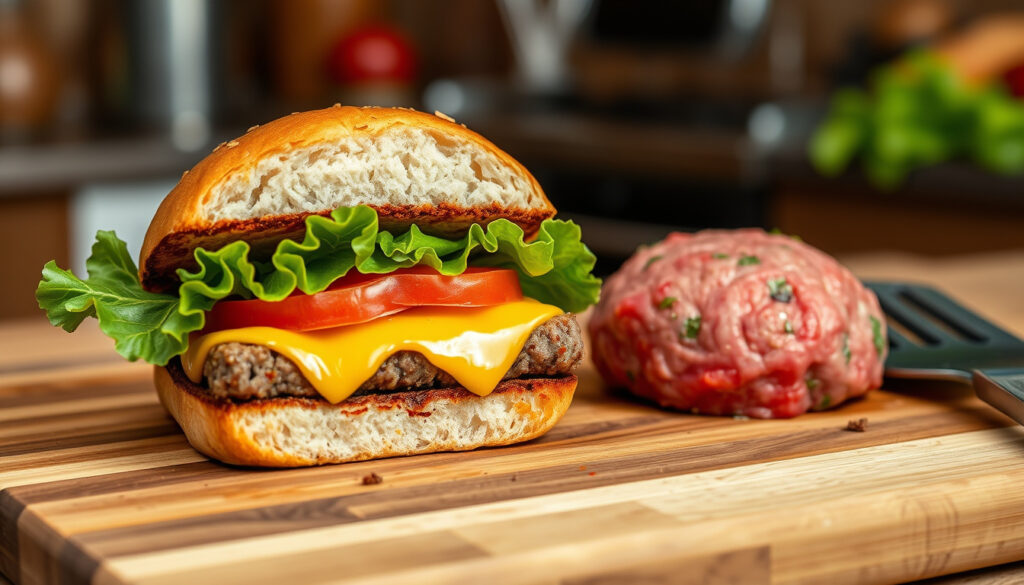
Anyone who has bitten into a burger and wondered why the edges taste so much better than the middle has probably encountered a smash burger. This thin, crispy patty has become a fast-casual phenomenon, but its roots go back decades.
Cooking time: 90 seconds to 2 minutes ·
Patty weight before smashing: 1½–2 oz (43–57 g) ·
Griddle temperature: 350–400°F (177–204°C) ·
Final thickness: ~¼ inch (6 mm) ·
US smash burger restaurants (2024 est.): ~4,500
Quick snapshot
- Made by pressing a ball of high‑fat beef (70–80% lean) onto a hot griddle (Wikipedia definition)
- Cooks in 90–180 seconds, creating a caramelized crust via the Maillard reaction (Culinary Arts Switzerland explainer)
- Exact inventor of the term “smash burger” is undocumented (FAQ section) (Tasting Table analysis)
- Whether Five Guys qualifies is debated by purists (Tasting Table analysis)
- Technique first recorded in the 1930s Depression‑era diners (The Kitchen at Priest Ranch history)
- Smashburger chain founded in 2007, trademarking the name (Tasting Table history)
- Expected to remain a dominant fast‑casual trend through the 2020s (Tasting Table forecast)
- More chains adopting the technique; variation with smashed‑on onions growing (The Kitchen at Priest Ranch trend report)
| Patty weight | 1.5–2 oz (43–57 g) before smashing |
| Cook time | 90 seconds to 2 minutes total |
| Griddle temperature | 350–400°F (177–204°C) |
| Final thickness | Approximately ¼ inch (6 mm) |
| Key chemical reaction | Maillard browning at ~310°F (155°C) |
The pattern: a handful of specs define the entire smash burger category.
What is a smash burger?
A smash burger is a hamburger made from a ball of ground beef pressed flat onto a hot griddle or skillet. The immediate, firm compression creates a thin patty with crispy, lacy edges. Because the meat is spread thin, it cooks in under two minutes, and the high‑heat contact triggers the Maillard reaction — a chemical process that produces deep browning and savory flavor.
The Maillard reaction is what gives a smash burger its signature crust. Regular burgers, cooked more gently, develop far less surface browning. That crust is the reason many burger lovers choose smash over traditional.
Key characteristics of a smash burger
- Uses high‑fat ground beef, typically 70–80% lean (Wikipedia definition)
- Pressed once, immediately after placing the ball on the griddle (Wikipedia technique)
- Final patty diameter 4–5 inches, thickness ¼ inch or less
How it differs from a regular burger
- Regular burgers are pre‑shaped and thicker, cooked to specified doneness (Culinary Arts Switzerland comparison)
- Smash burgers maximize surface area for browning; regular burgers prioritize internal juiciness
The trade‑off: a smash burger sacrifices a thick, juicy center for an intensely crispy exterior and faster cooking time.
What is the difference between a smash burger and a regular burger?
The core difference lies in patty construction and cooking method. A regular burger starts as a pre‑formed patty, often ¼ to ½ inch thick, and is cooked on a grill or flat‑top without pressing. A smash burger begins as a loose ball of beef that is flattened hard and fast onto a very hot surface.
Patty thickness and shape
- Regular: uniform thickness, often 4–6 oz, cooked to rare/medium/well
- Smash: thin (¼ inch), irregular edges, 1.5–3 oz, cooked well‑done
Cooking method and surface
- Regular: grilled or griddled, no smashing, moderate heat
- Smash: always on a flat‑top griddle at 350–400°F, pressed immediately
Texture and flavor profile
- Regular: soft interior, moderate browning, juicier
- Smash: crunchy, caramelized crust with a thin, tender center
Why this matters: the smash technique trades moisture for texture. For someone who values a crispy bite over a juicy drip, smash wins. For traditionalists who want a medium‑rare pink center, regular is the only choice.
What is the 5 6 7 burger rule?
The 5 6 7 rule is an informal guideline used by some chefs to standardize the smashing process. It helps achieve consistent crust and shape without overworking the meat.
Origin of the rule
- No single inventor is documented; it emerged from online recipe communities and short‑order kitchens.
- Often cited by food bloggers and YouTube channels as a memory aid.
Step‑by‑step: 5 seconds, 6 inches, 7 pounds
- 5 seconds: form a ball, place on griddle, and smash within 5 seconds to prevent the meat from cooking before pressing.
- 6 inches: the target diameter of the smashed patty, roughly 6 inches (15 cm).
- 7 pounds: the approximate downward pressure applied, equal to about 7 lbs (3.2 kg) of force.
Why it works
- Timing prevents premature searing that would make pressing harder.
- Uniform diameter ensures even cooking and fits standard buns.
- Consistent pressure creates lacy, thin edges without tearing the patty.
The catch: the 5 6 7 rule is a rough benchmark, not a scientific law. Actual pressure and timing depend on griddle temperature and patty size. It’s a useful starting point for home cooks.
Is Five Guys a smash burger?
No — Five Guys is not a smash burger by the standard definition. While the chain flattens its patties with a spatula during cooking, the method differs significantly from the smash technique.
Five Guys cooking method
- Patties are placed on a flat‑top griddle and then pressed down with a spatula, but not immediately upon contact.
- The grill temperature is not as extreme as dedicated smash burger joints.
- Patties remain thicker and lack the crispy, lacy edges that define a true smash burger (Tasting Table analysis).
Why it is not a true smash burger
- True smash burgers require instantaneous, forceful compression on a surface at 350–400°F to create the crust.
- Five Guys burgers are more accurately described as “flattened” or “thin‑pressed” burgers.
Comparison with dedicated smash burger chains
- Chains like Smashburger and Shake Shack use dedicated smashing tools and higher griddle temperatures to achieve the signature crust.
- Five Guys prioritizes toppings and a juicy interior over a crisp exterior.
What this means for the customer: if you’re craving a smash burger’s lacy crust, Five Guys will disappoint. If you want a tall, toppings‑heavy burger, Five Guys delivers.
Where did smash burgers originate?
The smash technique has multiple claimed origins, but the most concrete evidence points to the 1930s Depression era, when cooks stretched limited beef by pressing it thin with a spatula or even a bean can.
Depression‑era origins
- In 1932, during the Great Depression, a cook named Ross Davis in Oklahoma smashed beef with onions to bulk up patties (Tasting Table history).
- Another early reference: a diner in Ashland, Kentucky, where a cook used a No. 10 bean can to press beef (Culinary Arts Switzerland history).
Midwestern drive‑in innovations
- Food historian George Motz links thin pressed patties to late 19th‑ and early 20th‑century American fairs and factory lunch wagons (Wikipedia burger history).
- Drive‑ins in the 1940s and 1950s, like Steak ‘n Shake, made the flattened patty a staple.
Modern chain influence
- The term “smash burger” gained national traction when Smashburger opened in Denver in 2007 (Tasting Table history).
- The chain trademarked the name and sparked a wave of imitators.
The pattern: what started as a cost‑saving trick in hard times became a premium fast‑casual category 80 years later.
Comparison: Smash burger vs. regular burger
One key trade‑off, five dimensions: here’s how they stack up.
| Attribute | Smash burger | Regular burger |
|---|---|---|
| Patty thickness | ~¼ inch (6 mm) | ½–1 inch (12–25 mm) |
| Cooking time | 90 sec – 2 min | 4–8 min (depending on doneness) |
| Surface texture | Crispy, lacy edges with deep browning | Minimal browning, softer exterior |
| Interior juiciness | Moderate (fat renders into the crust) | High (retained moisture) |
| Equipment needed | Flat‑top griddle or cast‑iron skillet | Grill or griddle (both work) |
The implication: choosing between them is really about texture preference versus moisture preference. Smash burgers win for crust lovers; regular burgers win for those who want a juicy, medium‑rare bite.
Is a smash burger better than a regular burger?
“Better” depends on what you prioritize. Smash burgers offer more browning and crispy bits, which many people prefer. They also cook faster, reducing energy and time. Regular burgers can be cooked to varying doneness and provide a juicier interior.
Flavor and texture differences
- Smash burgers have a concentrated, roasted flavor from intense browning.
- Regular burgers have a more uniform beef taste with a soft‑juicy mouthfeel.
Health considerations
- Smash burgers use higher‑fat beef (20–30% fat) and are cooked well‑done, which may form more heterocyclic amines (HCAs) due to high heat (Culinary Arts Switzerland health note).
- Regular burgers can be made with leaner beef and cooked to lower doneness, potentially reducing HCA formation.
Cooking convenience
- Smash burgers take half the time and require less energy.
- Better suited for quick weekday meals; regular burgers are more versatile for entertaining.
The trade‑off: better texture versus better nutrition control — a personal call.
Upsides
- Intense, caramelized crust
- Quick cooking (under 2 minutes)
- Consistent results with simple technique
- Uses less meat per serving (1.5–2 oz patties)
Downsides
- No medium‑rare option (cooked well‑done)
- High‑fat beef required for moisture
- Potential for increased HCAs from high‑heat searing
- Requires a flat‑top griddle for best results
How to make a smash burger at home
A few simple steps, one piece of equipment: a cast‑iron skillet or flat‑top griddle. For more information, check out aliments que redueixen el colesterol.
- Form loose balls of 1.5–2 oz (43–57 g) high‑fat ground beef. Do not pack tightly.
- Preheat the griddle to 350–400°F (177–204°C). No oil needed if using non‑stick; a thin film on cast iron helps.
- Place a ball on the hot surface and immediately smash it flat using a heavy spatula or press. Apply firm, even pressure within 5 seconds.
- Season with salt and pepper while cooking. Cook for 45–60 seconds until the edges are lacy and browned.
- Flip and add cheese if desired. Cook another 30–45 seconds.
- Stack on a toasted bun with toppings of choice.
The catch: resist the urge to press again after the initial smash. Multiple presses squeeze out juices and prevent the crust from forming.
Timeline
- 1930s: Smash technique appears in short‑order diners to stretch meat and speed service (The Kitchen at Priest Ranch history).
- 1940s–1950s: Midwest drive‑ins like Steak ‘n Shake popularize the flattened patty.
- 2007: Smashburger chain founded in Denver, Colorado, bringing the style to national attention (Tasting Table history).
- 2010s: “Smash burger” becomes a common search term; many restaurants adopt the name.
- 2020s: Smash burgers become a dominant trend in fast‑casual and food media.
The signal: what began as a Depression‑era cost‑cutting trick became a 21st‑century premium burger category — a classic underdog story.
Confirmed facts
- Smash burgers are cooked on a flat‑top griddle at high heat (Wikipedia definition).
- The technique creates a thin, crispy patty with a caramelized crust (Culinary Arts Switzerland explainer).
- The 5 6 7 rule is an informal guideline used by some chefs.
- Origins trace to the 1930s Depression era (Tasting Table history).
What’s unclear
- Exact origin of the 5 6 7 rule (no single inventor documented).
- Whether Five Guys counts as a smash burger (debated among purists).
- The precise historical first use of the term “smash burger”.
Expert quotes
“A smash burger is made by pressing a ball of ground beef flat onto a hot griddle to create a thin patty with a crispy, caramelized crust.”
— Barney, chef, in Culinary Arts Switzerland
“The thin pressed patty dates back to late 19th‑century American fairs and factory lunch wagons.”
— George Motz, burger historian, via Wikipedia
“Smashburger did not invent the technique, but trademarked the name and challenged UK businesses using it.”
— Tasting Table
For the home cook, the choice is clear: if you want a quick, crust‑forward burger, invest in a cast‑iron skillet and high‑fat beef. If you prefer a juicy, customizable patty cooked to order, stick with the regular method. The smash burger isn’t superior — it’s different. And that difference is why it has earned its place on menus across the country.
For a deeper dive into the smash burger technique and history, including its Depression-era origins and the 5-6-7 rule, check out this detailed guide.
Frequently asked questions
What is the best meat for a smash burger?
High‑fat ground beef, ideally 70–80% lean (20–30% fat). The fat renders during cooking and contributes to the crispy crust and moisture.
Do you need a special spatula to make smash burgers?
A heavy, flat‑bottomed spatula or a dedicated burger press works best. A standard thin spatula may not provide enough force.
Can you make smash burgers on a grill?
Traditional grills with grates don’t allow the needed surface contact. Use a flat‑top griddle or cast‑iron skillet placed on the grill instead.
How do you keep a smash burger from falling apart?
Don’t overwork the meat before cooking. Form loose balls and press once firmly. The high heat will bind the patty as it cooks.
What cheese goes best on a smash burger?
American cheese is traditional because it melts evenly and complements the beef’s richness. Cheddar, Swiss, or pepper jack also work well.
Are smash burgers healthier than regular burgers?
They use less meat per serving, but the high‑fat content and high‑heat cooking may produce more HCAs. In moderation, neither is significantly healthier.
Related stories




Ryan Clarke is Senior Markets Reporter at True North Brief, covering breaking stories and explainers.