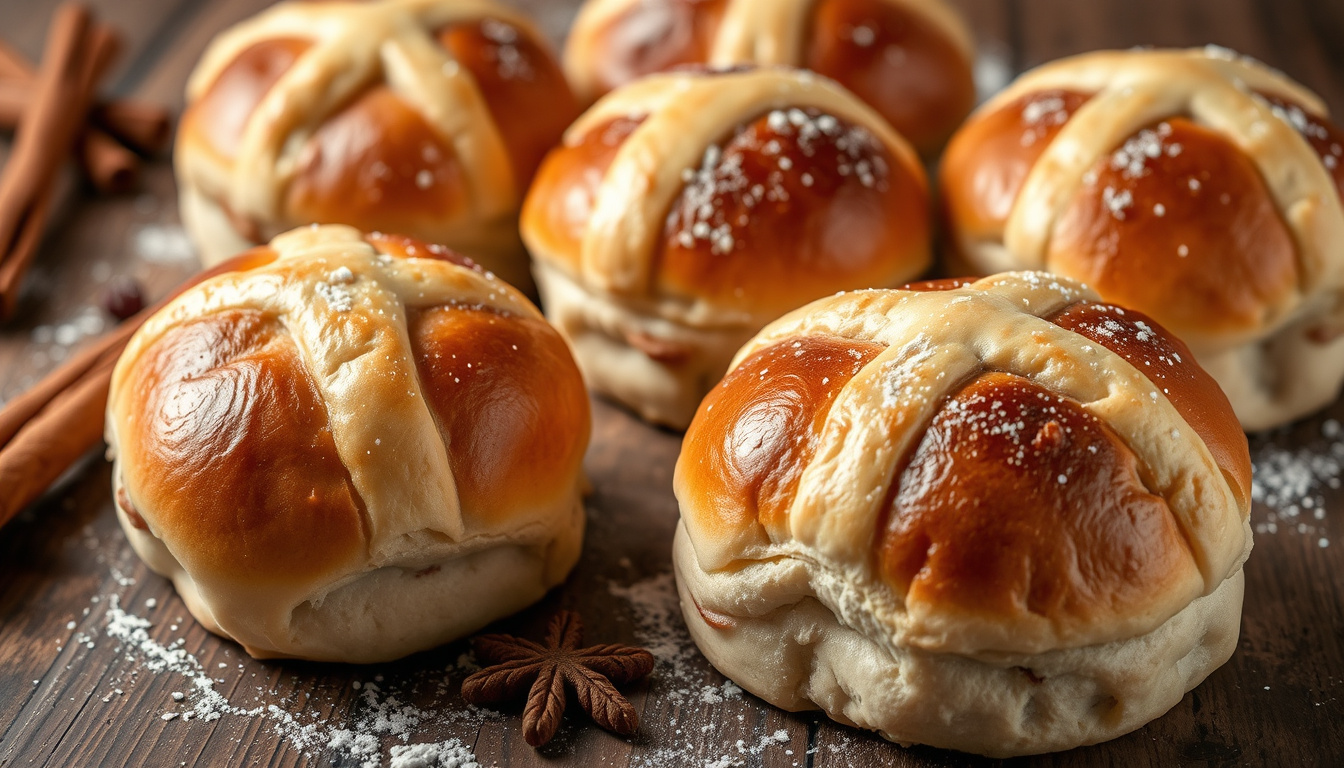

There’s something about the smell of warm spices and yeasted dough that signals Easter is near. First recorded in 1361, according to Wikipedia (the free encyclopedia), the hot cross bun has a surprising history — including a 16th-century ban — and a few tricks to make it just right. This guide walks you through the ingredients, technique, and common pitfalls so your buns turn out soft, fluffy, and full of flavour.
Milk: 300 ml (full-fat, plus extra for glaze) ·
Butter: 50 g ·
Strong bread flour: 500 g ·
Caster sugar: 75 g ·
Yield: 12 buns
Quick snapshot
- Hot cross buns are spiced sweet buns with a cross on top (Wikipedia)
- Traditionally eaten on Good Friday (English Heritage)
- 1592 ban documented by English Heritage (English Heritage)
- Strong bread flour yields better texture (multiple sources) (Wikipedia)
- Whether the cross originally represented pagan sun symbols or Christian crucifixion (English Heritage)
- Exact origin of the name “hot cross bun” – possibly from Old English “boun” (Wikipedia)
- 1361 – first recorded mention in an English text (Wikipedia)
- Flavour variations (chocolate, cheese) are expanding the bun’s appeal year-round (Jamie Oliver)
The table below lays out the key historical and factual markers that define hot cross buns today.
| Label | Value |
|---|---|
| Origin | England, first recorded reference in 1361 (Wikipedia) |
| Traditional day | Good Friday (Holy or heretical? English Heritage) |
| Cross meaning | Symbol of crucifixion, but pagan origins debated (English Heritage) |
| Ban history | 1592 Queen Elizabeth I banned spiced buns except at Easter (English Heritage) |
| Modern popularity | Sold year-round but peak at Easter (Wikipedia) |
What ingredients do hot cross buns have?
List of essential ingredients
- Strong bread flour (500 g) – the structural backbone (BBC GoodFood, RecipeTin Eats)
- Mixed spice (cinnamon, nutmeg, allspice, cloves) – 2–3 teaspoons (Jane’s Patisserie)
- Dried fruit – 150–200 g sultanas, currants, or raisins (Odiums)
- Butter (50 g), milk (300 ml), caster sugar (75 g), eggs (2 large), fast-action yeast (7 g sachet) – standard enrichments
Optional add-ins and variations
- Citrus zest (orange or lemon) brightens the flavour (RecipeTin Eats)
- Chocolate chips or chunks for a modern twist (Jamie Oliver)
- Cheese (cheddar or parmesan) for a savoury version (related search)
What are some common mistakes when making hot cross buns?
Overproofing the dough
- Leaving dough to rise too long causes flat, dense buns (RecipeTin Eats)
- Stick to 1–2 hours for first rise, 30–45 minutes for second rise
Using weak vs strong flour
- All-purpose flour (lower protein) produces less chewy, denser buns (Olivia’s Cuisine)
- Bread flour (12–14% protein) builds the gluten needed to hold the cross and fruit (RecipeTin Eats)
Incorrect oven temperature
- Baking too low prevents golden crust; too high burns the cross paste (BBC GoodFood)
- Target 350–400°F (180–200°C) for 20–30 minutes until deep golden
How to make hot cross buns soft and fluffy?
Tangzhong (water roux) method
- Tangzhong paste (flour + water heated to 65°C) locks in moisture, creating an ultra-soft crumb (The Flavor Bender)
- Add 2 tablespoons flour + 100 ml water, whisk until thick, then cool before adding to dough
Proper kneading and gluten development
- Knead 8–9 minutes on medium-low speed until dough passes the windowpane test (RecipeTin Eats)
- Dough should be sticky; do not add extra flour during kneading (Once Upon a Chef)
Steam during baking
- Place a shallow pan of boiling water in the oven to mimic a bakery steamer (BBC GoodFood)
- Steam keeps the crust soft and allows the bun to expand fully
What flour is best for hot cross buns?
Bread flour vs all-purpose flour
- Bread flour (12–14% protein) is the gold standard for enriched doughs like hot cross buns (Odiums, Olivia’s Cuisine)
- All-purpose flour (9–11% protein) yields softer but less structured buns – fine for a less chewy result (BBC GoodFood)
Why gluten content matters
- Gluten development ensures the bun holds its shape and the cross doesn’t crack during baking (RecipeTin Eats)
- Strong flour also withstands the weight of dried fruit and the tangzhong hydration
What gives hot cross buns their flavour?
Mixed spice blend
- Traditional mixed spice: cinnamon, nutmeg, allspice, cloves, and sometimes cardamom (Jane’s Patisserie)
- Some recipes add ginger or cayenne for a spicy kick (spicy variation)
Dried fruit and citrus zest
- Dried fruit adds sweetness and chew; sultanas and currants are classic (BBC GoodFood)
- Orange or lemon zest brightens the spice notes (RecipeTin Eats)
Optional additions: chocolate, cheese
- Chocolate chips: a modern favourite (Jamie Oliver)
- Cheese: cheddar or parmesan for a savoury twist (related search)
How to make hot cross buns: step-by-step recipe
Step 1: Make the tangzhong
- Mix 2 tbsp strong bread flour with 100 ml water in a small pan. Heat gently, whisking until a thick paste forms. Set aside to cool (Once Upon a Chef).
Step 2: Prepare the dough
- In a large bowl, combine 500 g strong bread flour, 75 g caster sugar, 2 tsp mixed spice, 1 tsp salt, and 7 g fast-action yeast. Add 50 g soft butter, 300 ml lukewarm milk, 2 beaten eggs, and the cooled tangzhong. Mix to a sticky dough (BBC GoodFood).
Step 3: Knead and first rise
- Knead for 8–9 minutes (stand mixer on medium-low) until smooth and elastic. Dough should pass the windowpane test. Place in a greased bowl, cover, and let rise until doubled – about 2 hours (RecipeTin Eats).
Step 4: Shape the buns
- Knock back the dough, knead in 150 g dried fruit, and divide into 12 equal pieces (about 95 g each). Shape into tight balls and place on a lined baking tray, leaving a little space between them (Cloudy Kitchen).
Step 5: Second rise and pipe the cross
- Cover and let rise for 30–45 minutes until puffed. Meanwhile, make the cross paste: mix 60 g flour, 20 g confectioners sugar, and 4–5 tbsp water to a piping consistency. Pipe a vertical and horizontal line on each bun (The Flavor Bender).
Step 6: Bake and glaze
- Bake at 350°F (180°C) for 20–25 minutes until deep golden brown. While hot, brush with a glaze of 3 tbsp strained apricot jam and 1 tbsp water (Olivia’s Cuisine).
The tangzhong method, combined with strong flour and proper glaze, ensures buns that stay soft for days. For home bakers: the extra step of making tangzhong is the single biggest upgrade from a mediocre bun to a bakery-quality one.
Timeline of hot cross buns
- 1361 – First recorded mention of hot cross buns in an English text (Wikipedia)
- 1592 – Queen Elizabeth I prohibits the sale of spiced buns except at Christmas, Easter, and burials (English Heritage)
- 1730 – Earliest known recipe for hot cross buns appears in a cookbook (English Heritage)
- 19th century – Hot cross buns become widely associated with Good Friday in the UK (English Heritage)
- 20th century – Commercial bakeries mass-produce buns; cross replaced by icing or paste (Wikipedia)
The pattern is clear: each century added a new layer to the bun’s cultural and legal identity.
What we know and what remains unclear
Confirmed facts
- Hot cross buns are spiced sweet buns with a cross on top (Wikipedia)
- They are traditionally eaten on Good Friday (English Heritage)
- The ban in 1592 is documented by English Heritage (English Heritage)
- Strong bread flour yields better texture (multiple sources)
What’s unclear
- Whether the cross originally represented pagan sun symbols or Christian crucifixion (English Heritage)
- Exact origin of the name “hot cross bun” – possibly from Old English “boun” (Wikipedia)
The debate over the cross’s symbolism remains unresolved. For historians, the pagan-vs-Christian origin is a fascinating puzzle. For home bakers, it doesn’t affect the recipe – but it adds a layer of cultural richness to every bite.
Expert perspectives on hot cross buns
“The cross on the bun may predate Christianity, but was later adopted as a Christian symbol.”
– English Heritage historian
“Bread flour is essential for the best results. Don’t overmix the dough – sticky is normal and leads to a tender bun.”
– A Sonoma baker from Olivia’s Cuisine
“Strong bread flour and a tangzhong starter create an especially soft crumb that stays fresh longer.”
– BBC GoodFood recipe editor (BBC GoodFood)
The implication: even experts agree that technique, not a secret ingredient, separates great buns from good ones. The cross’s history adds intrigue, but the real magic is in the dough.
Summary
Making perfect hot cross buns at home is entirely achievable with the right approach – tangzhong for softness, bread flour for structure, and careful proofing and baking. For home bakers, the choice is clear: embrace the extra steps of tangzhong and proper gluten development, or settle for a denser, drier bun. The historical journey from forbidden bread to Easter staple only makes the reward sweeter for those who master the technique.
Frequently asked questions
Can I freeze hot cross buns?
Yes, freeze after baking and cooling. Wrap individually in cling film and store in a freezer bag for up to 3 months. Thaw at room temperature or reheat directly from frozen.
How to reheat hot cross buns?
Reheat in a 350°F (180°C) oven for 5–7 minutes, or microwave for 15–20 seconds. For extra softness, wrap in foil and steam in the oven.
What is the best way to store hot cross buns?
Store in an airtight container at room temperature for up to 3 days. Do not refrigerate – that speeds up staling. For longer storage, freeze.
Can I use whole wheat flour instead of white?
Yes, but the buns will be denser and less fluffy. Substitute up to 50% whole wheat for a nuttier flavour, but increase liquid slightly as whole wheat absorbs more moisture.
How to make the cross on top without a piping bag?
Use a zip-top bag with a tiny corner snipped off, or simply dip a spoon handle in the paste and drizzle lines. The cross doesn’t need to be perfect – it’ll bake well.
Are hot cross buns vegan? Can I make them without eggs?
Traditional buns are not vegan because of eggs and butter. For a vegan version, replace butter with coconut oil or vegan butter, eggs with flaxseed eggs (1 tbsp ground flax + 3 tbsp water per egg), and use plant milk. The texture will be slightly different but still delicious.
How long do homemade hot cross buns stay fresh?
At room temperature, they stay soft for 2–3 days. The tangzhong method extends freshness by an extra day compared to standard recipes. After that, freeze any leftovers.
Related stories





Ryan Clarke is Senior Markets Reporter at True North Brief, covering breaking stories and explainers.