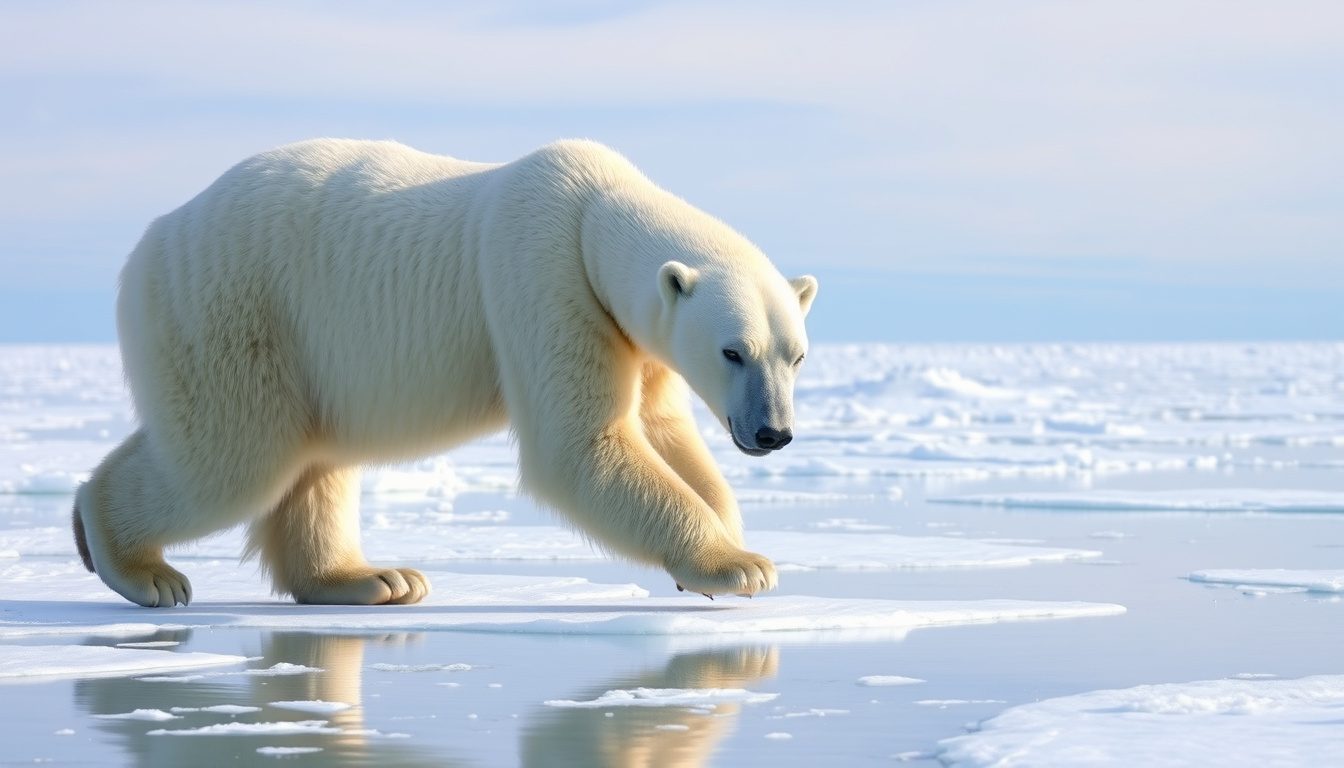
There’s something about a polar bear that stops you in your tracks—maybe it’s the sheer size, or the fact that it’s the only bear considered a marine mammal. Yet as sea ice shrinks, this Arctic apex predator is confronting a challenge that even its 40 km/h sprint can’t outrun.
Adult male weight: 300–800 kg (660–1,760 lb) ·
Estimated global population: 22,000–31,000 ·
Primary habitat: Arctic sea ice ·
IUCN status: Vulnerable ·
Top speed (land): 40 km/h (25 mph)
Quick snapshot
- Largest land carnivore, adult males 300–800 kg (Polar Bear Range States)
- Global population estimated 22,000–31,000 (World Wildlife Fund)
- IUCN Red List status: Vulnerable (Polar Bear Range States)
- Depend on sea ice for hunting seals (Marine Mammal Commission)
- Exact population trend for all 19 subpopulations; some are data-deficient (WWF)
- Long-term reproductive impact of reduced sea ice duration (Polar Bears International)
- Outcome of the next IUCN/SSC assessment (2025–2027) is uncertain (Polar Bears International)
- Precise effect of climate change varies across subpopulations (WWF)
- 1973: International Agreement on Conservation of Polar Bears signed (Wikipedia)
- 2006: IUCN classifies polar bear as Vulnerable (Wikipedia)
- 2008: U.S. lists as threatened under Endangered Species Act (Marine Mammal Commission)
- 2023: U.S. review reaffirms threatened status (Marine Mammal Commission)
- IUCN/SSC Polar Bear Specialist Group assessment planned for 2025-2027 (Polar Bears International)
- Continued sea ice loss expected to increase starvation risk (Polar Bears International)
The table below summarizes key measurements and conservation data for polar bears.
| Attribute | Value | Source |
|---|---|---|
| Scientific name | Ursus maritimus | Wikipedia |
| Average male weight | 300–800 kg | Polar Bear Range States |
| Average female weight | 150–300 kg | Polar Bears International |
| Length (nose to tail) | 2.4–3.0 m | World Wildlife Fund |
| Shoulder height | 1.3–1.6 m | Wikipedia |
| Lifespan in wild | 25–30 years | IFAW |
| Top speed (land) | 40 km/h | Polar Bears International |
| Swimming speed | 10 km/h | IFAW |
What are 5 facts about polar bears?
Size and weight of polar bears
- Polar bears are the largest land carnivore on Earth. Adult males typically weigh 300–800 kg, while females weigh 150–300 kg (Polar Bear Range States).
- From nose to tail they measure 2.4–3.0 m and stand 1.3–1.6 m at the shoulder (World Wildlife Fund).
Eight items, one pattern: polar bears are built for power and endurance, not speed. Their large bodies store fat for long periods without food.
A male polar bear can weigh as much as a small car. That bulk is essential for surviving months on the sea ice with only sporadic meals.
The pattern: every adaptation ties back to the demands of a sea‑ice lifestyle.
Where polar bears live
- Polar bears inhabit Arctic regions of Canada, Alaska, Greenland, Russia, and Norway (Polar Bear Range States).
- They are strongly associated with sea-ice habitats, which they use as platforms for hunting seals (Marine Mammal Commission).
The Arctic is their home, but it’s a home that’s literally melting beneath them. Because sea ice is retreating due to climate change, polar bears are spending more time on land, where hunting is less productive. For more on natural resources, see our guide on Sea Salts: Benefits, Types, and Healthiest Options.
Polar bear diet and hunting
- Polar bears primarily eat ringed and bearded seals (IFAW).
- They succeed in only about 2% of hunting attempts, which is why they spend roughly 50% of their time hunting (IFAW).
The catch: polar bears are efficient swimmers but inefficient hunters. Their low success rate means any reduction in sea ice—and thus seal access—directly threatens their energy balance.
How many polar bears are left?
Current polar bear population estimates
The global polar bear population is estimated at 22,000–31,000, with a central figure of roughly 26,000 (Polar Bear Range States). The IUCN/SSC Polar Bear Specialist Group recognizes 19 subpopulations across the Arctic. Some estimates place the largest subpopulations—such as Baffin Bay and Chukchi Sea—at roughly 2,000–3,000 individuals, while the smallest (Norwegian Bay, Viscount Melville Sound) are around 150–200 (IELC LibGuides).
Threats to polar bear survival
- Sea ice loss is the primary threat, driven by climate change. The Western Hudson Bay population dropped 27% in five years according to a 2021 aerial survey (Polar Bears International).
- The Southern Beaufort Sea population plunged about 40% over a 2001–2010 study period (Polar Bears International).
- In 2019, the number of declining subpopulations increased to four, while two were increasing, five were stable, and eight were data-deficient (World Wildlife Fund).
What this means: conservation actions must accelerate to match the pace of ice loss.
Are polar bears aggressive?
Polar bear behavior toward humans
Polar bears are generally not aggressive toward humans unless provoked or starving. However, as powerful predators, they can be dangerous. Most attacks involve hungry or stressed bears, often males that have been unable to find seals (IFAW).
Comparison with other bear aggression
Grizzly bears are considered more aggressive in confrontations with humans. Polar bears, by contrast, are more likely to avoid people—but when they do attack, the outcome is often fatal due to their size. The trade-off: a hungry polar bear is arguably more dangerous than a grizzly, because it has fewer alternative food sources and will take greater risks.
Polar bear vs. grizzly bear: how do they compare?
Three key differences, one pattern: polar bears are larger and specialized for marine life, while grizzlies are more adaptable and aggressive in defense.
| Attribute | Polar bear | Grizzly bear |
|---|---|---|
| Adult male weight | 300–800 kg | 180–360 kg |
| Shoulder height | 1.3–1.6 m | 0.9–1.5 m |
| Primary habitat | Arctic sea ice | Forests, tundra, mountains |
| Diet | Seals (primarily) | Berries, fish, small mammals, carrion |
| Aggression toward humans | Low unless starving | Moderate–high; defensive |
| Top speed | 40 km/h (25 mph) | 48 km/h (30 mph) |
The implication: polar bears are heavier and more specialized, but grizzlies are faster and more willing to stand their ground. In a hypothetical matchup, the polar bear’s size advantage would be offset by the grizzly’s aggression and adaptability.
What eats a polar bear and what is the biggest killer?
Natural predators of polar bears
Adult polar bears have no natural predators. Cubs may be killed by wolves or other bears, but the only real threat to an adult is another polar bear or humans (World Wildlife Fund).
Human-related threats
Climate change and sea ice loss are the biggest killers of polar bears. Starvation due to reduced hunting opportunities is the primary mechanism. The IUCN/SSC Polar Bear Specialist Group has planned a new population assessment for 2025–2027 to track these impacts (Polar Bears International). For a related outdoor perspective, see our guide on Mount Washington: Deaths, Difficulty, and How to Visit Safely.
Timeline of polar bear conservation
- 1973 – International Agreement on the Conservation of Polar Bears signed by five Arctic nations
- 2006 – IUCN Red List classifies polar bear as Vulnerable
- 2008 – U.S. lists polar bear as threatened under Endangered Species Act
- 2015 – Circumpolar Action Plan adopted by Arctic states
- 2023 – U.S. Fish and Wildlife Service completes 5-year review, keeps threatened status
What this means: every major international policy milestone has occurred in the last 50 years, and the trend line is clear—protective measures are not keeping pace with ice loss.
Confirmed facts
- Polar bears are the largest land carnivore
- They depend on sea ice for hunting seals
- Global population estimated 22,000–31,000
- IUCN status is Vulnerable
What’s unclear
- Exact population trend for all 19 subpopulations
- Long-term impact of reduced sea ice on reproduction rates
- Outcome of next IUCN/SSC assessment (2025–2027)
- Precise effect of climate change across different subpopulations
“Polar bears are living on borrowed time as sea ice disappears. The window to act is closing faster than we thought.”
— WWF polar bear expert, in a 2024 conservation briefing
“We count polar bears from helicopters and drones. Every survey tells us that where ice is thin, bears are fewer.”
— Researcher at Polar Bears International, discussing population monitoring methods
For the Arctic, the implication is stark: polar bears will not adapt to a world without sea ice. The choice for policymakers is clear: aggressively reduce carbon emissions, or accept that the largest land carnivore will retreat to the northernmost refuges—and eventually vanish from much of its range.
polarbearscience.com, cowboystatedaily.com, polarbearagreement.org, youtube.com, ebsco.com, reddit.com
Frequently asked questions
How fast can a polar bear run?
Polar bears can run up to 40 km/h (25 mph) on land, but they tire quickly and prefer to ambush prey.
What do polar bears eat besides seals?
They occasionally scavenge carcasses of walruses, whales, and other marine mammals, but seals are their primary food source (IFAW).
How long do polar bears live?
In the wild, polar bears typically live 25–30 years, though some have been known to reach 30+ (World Wildlife Fund).
Where do polar bears sleep?
Polar bears sleep on the sea ice, often curling up in a snow bank or using their paws as a pillow. They do not make permanent dens except during maternity.
Can polar bears swim?
Yes, they are strong swimmers, capable of covering long distances at up to 10 km/h. They use their front paws to paddle and hind legs to steer.
Do polar bears hibernate?
Only pregnant females enter a winter den to give birth. Other polar bears remain active year-round, though they may reduce activity during severe weather.
How many cubs do polar bears have?
Litters typically consist of 1–3 cubs, with twins being most common. Cubs stay with their mother for about 2.5 years.
Related stories





Daniel Campbell is Editor-in-Chief at True North Brief, overseeing editorial standards, publication decisions and corrections.